
Sales Deck Design: How to Create a Deck That Helps Close Deals
A strong sales deck design helps buyers understand the problem, see the value of your solution, trust your proof, and feel confident about taking the next step. In B2B sales, that confidence is critical. Buyers are no longer waiting for a salesperson to explain everything. They research independently, compare options quietly, and often share your deck internally with people who were not part of the meeting.
That means your sales deck has two jobs.
- It must support the live sales conversation.
- It must also sell when your sales team is not in the room.
According to Gartner, many B2B buyers now prefer digital and self-guided buying experiences, but they still need clear information and human support to make high-quality purchase decisions. This is where a well-designed sales deck becomes valuable. It connects your sales conversation, digital content, proof points, and next steps into one clear buyer journey.
Why Sales Deck Design Plays a Bigger Role Today
Modern B2B buying is no longer linear. A prospect may visit your website, download a guide, attend a discovery call, compare you with competitors, forward your deck to finance, and then ask procurement for input.
McKinsey’s B2B research shows that buyers now expect a mix of in-person, remote, and digital self-service interactions. Buyers are comfortable making large purchase decisions through hybrid buying journeys, which means your sales content must be clear enough to support both live conversations and internal review.
So the sales deck is no longer just “the presentation.” It is part of the buyer’s decision-making process.
A good sales deck helps answer:
| Buyer Question | What Your Sales Deck Should Do |
|---|---|
| Do they understand our problem? | Show the real business pain, not just product features |
| Is this relevant to our situation? | Personalize by industry, role, or use case |
| Why act now? | Show cost of delay, urgency, and risk |
| Why this solution? | Connect capabilities to business outcomes |
| Can we trust them? | Use proof, case studies, testimonials, numbers, and process clarity |
| What happens next? | Give a simple decision path and clear next step |
What Buyers Need From Your Deck
A sales deck often fails because it talks too much about the seller too early.
Many decks start with:
- “We are a leading provider…”
- “We offer end-to-end solutions…”
- “Our platform has these features…”
But buyers are thinking:
- “Do you understand my problem?”
- “Can you help me make a confident decision?”
- “Can I explain this internally without confusion?”
Buyers select products mainly because they met their needs at the best price, felt like the safest or most trusted option, or came from a vendor they already knew. This tells us something important: buyers are not only looking for impressive demos. They are looking for fit, trust, clarity, and reduced risk.
Why Buyers Select a Product
| Reason Buyers Selected the Product | Percentage |
|---|---|
| It met our needs for the best price | 66% |
| It was the safest, most trusted option | 39% |
| We already had a relationship with the vendor | 29% |
| Existing customers gave us confidence | 16% |
| The demo impressed us | 13% |
Buyers choose when the value, trust, fit, and risk feel clear.
This is a useful reminder for sales deck design. The deck should not simply impress. It should reduce doubt.
The Best Sales Decks Follow a Buyer-Led Narrative
The best sales decks begin with the buyer’s world, not the seller’s company. They explain what is changing, why the buyer should pay attention, what problem needs solving, and why your solution is the right fit.
A useful sales deck structure looks like this:
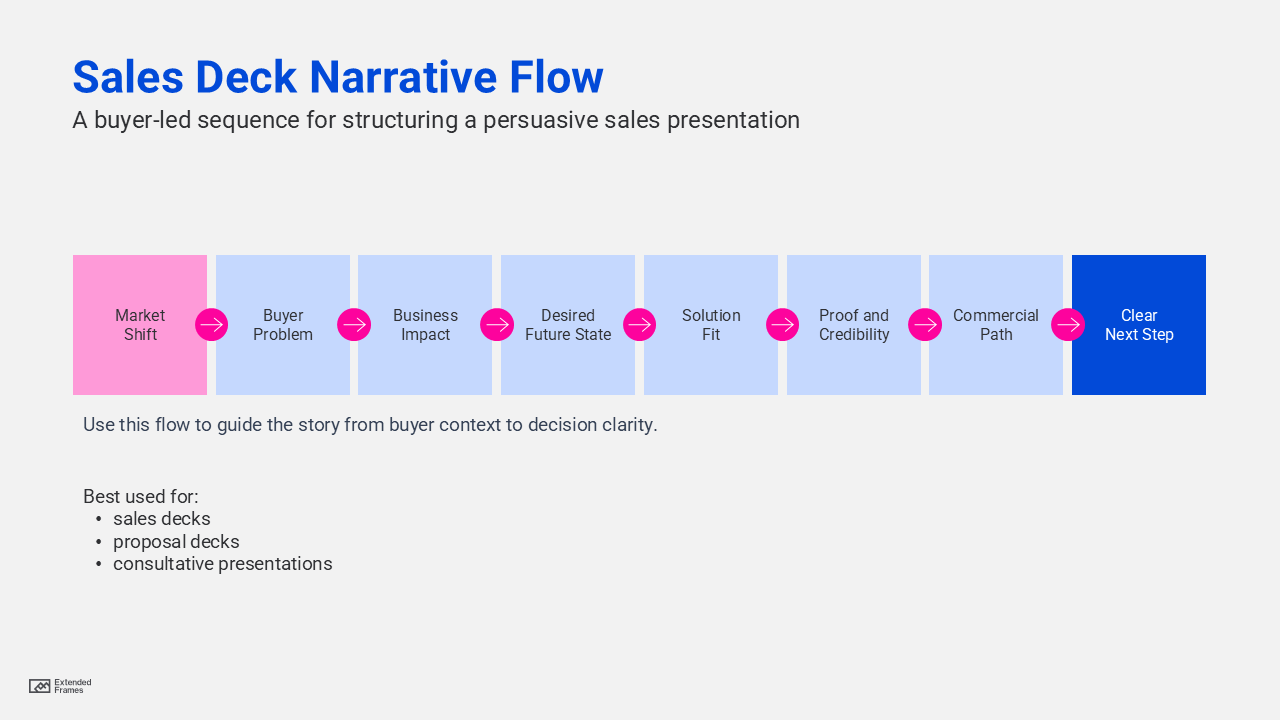
Sales Deck Narrative Flow
| Stage | Slide Purpose | Buyer Reaction You Want |
|---|---|---|
| Market shift | Show what has changed | “Yes, this is happening to us.” |
| Problem | Name the pain clearly | “They understand our situation.” |
| Impact | Quantify the cost of delay | “This is worth solving now.” |
| Solution | Present your approach | “This feels relevant.” |
| Proof | Show evidence and credibility | “This feels safe.” |
| Plan | Explain process, timeline, and next steps | “This feels doable.” |
| Decision | Ask for the next action | “We know what to do next.” |
Slide-by-Slide Sales Deck Structure
Here is a an example sales deck design structure that works well for B2B services, SaaS, consulting, design services, and solution-based selling.
| Slide | Slide Title Example | Purpose | Design Tip |
|---|---|---|---|
| 1 | Helping [Client] Improve [Outcome] | Make the deck feel personalized | Use client name, industry cue, and one clear outcome |
| 2 | The Buying Reality Has Changed | Show market context | Use one bold data point or simple chart |
| 3 | The Problem We See | Name the pain | Use three concise pain points with icons |
| 4 | Why This Needs Attention Now | Build urgency | Show cost, delay, missed revenue, or risk |
| 5 | What Good Looks Like | Define the future state | Use a before and after comparison |
| 6 | Our Recommended Approach | Introduce your solution | Use a simple framework or process diagram |
| 7 | How It Works | Explain steps | Use a timeline or workflow |
| 8 | Proof It Works | Build trust | Use case study, testimonial, numbers, or logos |
| 9 | Commercial Options | Make pricing easier to understand | Use tiered packages or scope table |
| 10 | Next Steps | Close with action | Show three clear steps, owner, and timeline |
Example Slide 1: Personalized Opening Slide
Slide title: Helping Acme Consulting Turn Complex Ideas Into Client-Ready Sales Presentations
Subtitle: A practical design partnership for faster, clearer, and more consistent sales communication.
Visual idea: Use a clean hero layout with the client logo, your logo, one outcome statement, and a subtle visual related to their industry.
What this slide does: It immediately tells the buyer this is not a generic deck. It is about their business, their problem, and their desired outcome.
Example Slide 2: Market Shift Slide
Slide title: B2B Buyers Are Doing More Research Before They Speak to Sales
Body copy example: Buyers expect digital content, self-service research, remote conversations, and human support to work together. Your sales deck needs to explain value clearly enough to support both the live call and the internal buying conversation.
Why this works: This slide gives context. It shows why the buyer needs better sales content, not just a prettier presentation.
Example Slide 3: Problem Slide
Slide title: Your Best Sales Message Is Not Always Reaching the Final Decision-Maker
Body copy example: Many sales decks are built for the presenter, not the buying committee. Once the deck is forwarded internally, the story becomes weaker because the slides depend too heavily on verbal explanation.
Design tip: Use short phrases. Avoid paragraphs. The slide should be understood in five seconds.
Example Slide 4: Cost of Delay Slide
Slide title: When the Sales Story Is Unclear, Deals Slow Down
| Sales Deck Problem | Business Impact |
|---|---|
| Too much company information upfront | Buyer loses interest early |
| Feature-heavy slides | Value is unclear |
| Weak proof | Decision feels risky |
| No clear next step | Deal stalls |
| Poor internal readability | Champion struggles to sell internally |
Example Slide 5: Before and After Slide
Slide title: From Presenter-Led Slides to Buyer-Ready Sales Content
| Before | After |
|---|---|
| Generic company intro | Personalized buyer context |
| Dense feature lists | Outcome-led messaging |
| Visual decoration | Decision-support visuals |
| One deck for everyone | Modular slides by persona |
| Ends with “Thank You” | Ends with a decision path |
Example Slide 6: Solution Framework Slide
Slide title: A Better Sales Deck Connects Story, Proof, and Decision Clarity
Story
What is changing, and why should the buyer care?
Proof
Why should the buyer believe you?
Decision
What should the buyer do next?
Why this works: A simple framework makes your sales approach easier to remember. It also helps the buyer explain your value to others.
Example Slide 7: Proof Slide
Slide title: Proof That Reduces Buyer Risk
Buyers want evidence. They want to know that your solution has worked before, that your process is reliable, and that choosing you will not create unnecessary risk.
| Proof Type | Best Used For | Slide Format |
|---|---|---|
| Case study | Showing results | Problem, solution, outcome |
| Client logo | Building recognition | Logo strip with context |
| Testimonial | Building trust | Pull quote with role and company |
| Data point | Showing measurable value | Metric card or chart |
| Process proof | Reducing delivery fear | Timeline or workflow |
| Before and after | Showing transformation | Visual comparison |
Example Slide 8: Pricing or Commercial Options Slide
Slide title: Flexible Engagement Options Based on Sales Content Needs
| Option | Best For | Includes |
|---|---|---|
| Sales Deck Refresh | Existing deck needs better clarity and polish | Messaging cleanup, slide redesign, visual consistency |
| Sales Deck Redesign | Existing content needs stronger story and structure | Narrative flow, slide design, charts, proof slides |
| Sales Enablement System | Teams need repeatable deck assets | Modular deck, templates, persona slides, reusable visuals |
Design tip: Avoid making pricing slides feel like a spreadsheet. Use cards, clear labels, and short decision criteria.
Example Slide 9: Next Steps Slide
Slide title: Recommended Next Steps
- Align on sales goal and audience
- Audit current deck and proof points
- Build a buyer-ready deck structure
- Design and refine the final presentation
- Equip the team with reusable slide modules
What Great Sales Deck Design Gets Right
A high-performing sales deck usually has these qualities:
| Design Element | Why It Is Important |
|---|---|
| One message per slide | Reduces confusion |
| Action-oriented slide titles | Helps buyers scan the story |
| Strong visual hierarchy | Guides attention |
| Clear proof points | Builds trust |
| Modular structure | Makes the deck easier to personalize |
| Buyer-focused language | Keeps the conversation relevant |
| Simple charts | Makes data easier to understand |
| Strong closing slide | Moves the deal forward |
What to Avoid
Many sales decks lose buyers because they try to say everything at once.
| Mistake | Why It Hurts the Deal |
|---|---|
| Starting with a long company history | Delays relevance |
| Using too much text | Makes the deck hard to scan |
| Overloading charts | Hides the insight |
| Showing features without outcomes | Makes value unclear |
| Using generic stock visuals | Weakens credibility |
| Ending with only “Thank You” | Misses the close |
| Using the same deck for every buyer | Makes the pitch feel generic |
Design for Different Buyer Roles
A B2B sales deck often needs to work for multiple stakeholders. Each role looks for different evidence.
| Buyer Role | What They Care About | Slide Content They Need |
|---|---|---|
| CEO or Founder | Growth, risk, speed, strategic fit | Business impact, urgency, proof |
| Sales Leader | Pipeline, close rate, team adoption | Use cases, process, results |
| Marketing Leader | Brand consistency, messaging, campaign support | Visual quality, story, content system |
| Finance | Cost, ROI, predictability | Pricing, business case, value |
| Operations | Implementation effort | Timeline, responsibilities, workflow |
| Procurement | Risk, terms, vendor reliability | Scope, compliance, references |
This is why one-size-fits-all sales decks often underperform. A better approach is to create a core sales deck with modular slides that can be swapped based on the buyer’s role, industry, deal stage, and concern.
How to Design Charts for a Sales Deck
Charts in a sales deck should not simply show data. They should make the buyer understand the point faster.
| If You Want to Show | Use This Chart |
|---|---|
| Comparison between options | Bar chart |
| Change over time | Line chart |
| Parts of a whole | Stacked bar or donut chart |
| Process or sequence | Timeline |
| Cause and effect | Flow diagram |
| Before and after | Split-screen comparison |
| Priority ranking | Horizontal bar chart |
Example Chart Concept: Deal Friction Audit
| Sales Deck Weakness | Deal Risk |
|---|---|
| Unclear value proposition | High |
| Weak proof | High |
| Dense slides | Medium |
| No buyer-specific messaging | High |
| No next-step clarity | Medium |
Design Checklist
Before sending or presenting your sales deck, check these points:
| Checklist Item | Yes or No |
|---|---|
| Does the first slide clearly say who the deck is for? | |
| Does the deck mention the buyer’s problem before your company background? | |
| Does every slide have one clear message? | |
| Are the slide titles written as meaningful statements? | |
| Are charts simplified and labeled clearly? | |
| Is there proof for the claims that count most? | |
| Can the deck be understood without a presenter? | |
| Is there a clear next step at the end? | |
| Is the deck visually consistent with the brand? | |
| Can the sales team customize it quickly? |
Design Example: A Better Slide Title System
Weak slide titles describe the topic. Strong slide titles communicate the point.
| Weak Slide Title | Stronger Slide Title |
|---|---|
| About Us | We Help B2B Teams Turn Complex Offers Into Clear Sales Stories |
| Market Trends | Buyers Now Expect Clear, Self-Service Sales Content |
| Our Services | A Design Partnership Built Around Speed, Clarity, and Consistency |
| Case Study | How One Sales Team Reduced Deck Rework and Improved Buyer Clarity |
| Pricing | Flexible Engagement Options Based on Your Sales Content Needs |
| Next Steps | A Simple Path to Launching Your Buyer-Ready Sales Deck |
How Long Should a Sales Deck Be?
For most B2B sales conversations, a practical sales deck is usually 10 to 15 core slides, supported by optional appendix slides.
| Deck Type | Recommended Length |
|---|---|
| Introductory sales deck | 8 to 10 slides |
| Discovery follow-up deck | 10 to 12 slides |
| Proposal deck | 12 to 18 slides |
| Enterprise sales deck | 15 to 25 slides with appendix |
| Leave-behind version | 10 to 15 self-explanatory slides |
The goal is not to hit a perfect slide count. The goal is to create decision clarity.
- It helps buyers understand the problem.
- It shows why the problem deserves attention now.
- It explains your solution in plain language.
- It gives proof that reduces risk.
- It makes the next step easy.
In B2B buying environment, your sales deck may be read by people who never joined the call. It may be forwarded to finance, leadership, procurement, or a technical evaluator. If the deck depends too much on the presenter, the story weakens as soon as it leaves the meeting.
A strong sales deck keeps working after the call ends. It gives your buyer the confidence to move forward and the language to bring others with them.