
Brand architecture is the way a company organizes its parent brand, products, services, sub-brands, divisions, and acquired brands. It shows what belongs together, what needs separation, and what should stop pretending to be a brand. The Brand Consultancy describes brand architecture as the structure that helps audiences understand relationships across brands, sub-brands, and products.
For B2B companies, this work affects far more than naming. It changes how sales teams explain the offer, how designers build templates, how marketers plan campaigns, how buyers compare options, and how much trust each new offer can borrow from the parent company.
A brand guide documents the rules after the big decisions are made. Brand architecture makes those decisions first. Extended Frames covers the documentation side in Brand Guidelines: What to Include in a Brand Style Guide, which explains how teams should manage logo use, colors, typography, imagery, templates, voice, and brand ownership.
Kevin Lane Keller’s customer-based brand equity research defines brand equity around the effect of brand knowledge on consumer response. A brand name has value when people recognize it and connect it with the right meaning.
Relationship before the name
A company does not need a new brand every time it launches something. A branded house keeps the parent brand in front. Apple is a clear example. Its site keeps the Apple brand close to Mac, iPad, iPhone, Watch, Vision, AirPods, TV and Home, Entertainment, Accessories, and Support. The product names are visible, but the parent brand carries the trust.
A house of brands gives individual brands more room. P&G lists separate brands across baby care, fabric care, grooming, hair care, home care, oral care, and other categories, including Pampers, Ariel, Tide, Gillette, Always, and Braun. The buyer may know the product brand before thinking about the corporate owner.
An endorsed brand keeps its own name while showing a connection to the parent company. This can work for an acquired company, a specialist division, or a product with its own audience.
A hybrid structure mixes the models. Marriott groups its hotel brands by tier and defines them as Classic, Lifestyle, or Collection, so guests can choose by travel need, mood, and trip purpose. Alphabet describes itself as a collection of companies, with Google as the largest, while other businesses sit farther away from Google’s main internet products.
The relationship should come before the name. Otherwise, every launch turns into a naming debate.
Kevin Lane Keller’s customer-based brand equity work ties brand value to what people know, remember, and associate with a brand. A name carries value when people connect it with the right meaning. A name with no clear meaning is only another label to manage.
The main brand architecture models
| Model | How it works | Best fit | Watch-out |
|---|---|---|---|
| Branded house | One parent brand carries the main trust | Related services, shared audience, simpler marketing | One reputation issue can affect the whole brand |
| Sub-brand | Parent brand stays visible, product name adds distinction | Product lines with clear differences | Too many sub-brands can crowd the system |
| Endorsed brand | Independent brand gets support from the parent | Acquisitions, niche offers, specialist divisions | The endorsement needs a clear role |
| House of brands | Each brand stands mostly alone | Different audiences, price points, categories | Higher marketing cost and harder internal control |
| Hybrid | Mix of models | Large or evolving portfolios | Needs strong rules or it becomes messy fast |
How to choose the right model
Start with the buyer, ask what the customer needs to understand before they trust the offer. If the same buyer can use several services, a branded house is often cleaner. If the buyer sees each offer as a different category, a sub-brand or endorsed brand may help. If the audience, price point, promise, and channel are completely different, a separate brand may make sense.
Use these example questions before naming anything new:
- Does this offer serve the same audience as the parent brand?
- Does the parent brand add trust or create confusion?
- Will the new name need its own marketing budget?
- Can the sales team explain the relationship in one sentence?
- Will this name still make sense in three years?
- Does this offer need a logo, or does it need a clearer product descriptor?
- Would customers search for this as a separate solution?
A simple brand architecture map
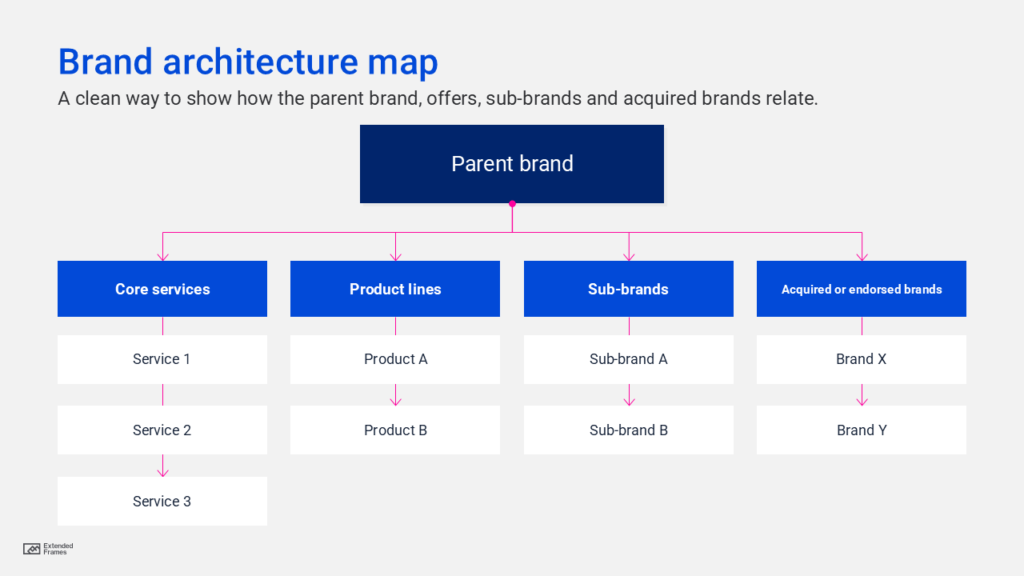
Then add four labels to each item: audience, promise, relationship to parent, and visual treatment.
That gives design teams useful direction. Should the parent logo appear first? Should the product name lead? Should the acquired brand keep its identity for a while? Should the sub-brand use its own color? These choices belong in the architecture before they become brand guideline rules.
Extended Frames already explains why clear brand documentation matters in the Brand Guidelines article. The same logic applies here, but one level higher. The architecture decides the relationships. The guidelines decide the usage.
What to document in your brand architecture
A useful brand architecture document should be short enough for teams to use. Include these sections:
Parent brand role: Define what the parent brand stands for and where it must appear.
Portfolio map: Show every product, service, division, sub-brand, and legacy brand.
Naming rules: Set clear rules for product names, service names, campaign names, and internal project names.
Logo relationship rules: Explain when to use the parent logo, product name, endorsement line, or separate identity.
Messaging relationship: Write the one-sentence relationship between each offer and the parent brand.
Migration plan: List names to keep, rename, merge, retire, or redirect.
Ownership: Assign one person or team to approve new names and brand changes.
This is where Extended Frames can support the work through Creative Consulting and Creative Design Services, especially when the architecture needs to be translated into sales collateral, templates, brand toolkits, website visuals, and presentation systems. Extended Frames’ creative services include brand identity, templates, sales collateral, infographics, and on-brand assets for B2B teams.
Brand architecture and presentations
Brand architecture becomes very visible in decks. A sales deck may need to explain the parent company, a product suite, three services, and a partner offer within ten slides.
For investor decks, product decks, and capability presentations, architecture affects slide titles, section dividers, proof points, diagrams, and logo placement. Extended Frames’ Presentation Design Services already focus on clarifying message, structure, visual direction, and editable PowerPoint output for B2B teams. Brand architecture gives that work a stronger base.
A clean slide system might use this logic:
- Parent brand = credibility
- Product family = category
- Product name = specific solution
- Feature name = proof or capability
This keeps the deck from treating every feature like a brand. That one habit alone can remove a lot of noise.
What to avoid
- Avoid giving every offer a name. Names feel exciting internally. Customers see another thing to decode.
- Letting departments create their own labels. Product, sales, marketing, and leadership may describe the same offer in different words.
- Keeping acquired brands forever with no plan. Some acquired names deserve long-term independence. Others need a transition path into the parent brand.
- Treating brand architecture as a design-only decision. This work affects business strategy, sales clarity, search visibility, customer trust, and internal adoption.
Brand architecture is a decision system for growth. It helps a company decide which names deserve attention, which offers should sit under the parent brand, and which parts of the portfolio need their own identity.
It is the structure customers can understand, sales teams can explain, marketers can promote, and designers can apply without guessing.
For a B2B company with multiple services, products, or sub-brands, this work saves time across every visible asset: websites, presentations, brand kits, proposals, social campaigns, videos, and sales collateral. Get the architecture right first, then let the visual system do its job.