
Content Repurposing Strategy: How to Turn One Idea Into Many Assets
A content repurposing strategy helps a B2B team get more value from every serious idea it creates. A blog article can become a LinkedIn carousel, a short video, a sales one-pager, a webinar segment, an email, a presentation slide, and a follow-up post. The real work is deciding what the idea should do in each format and not copying the same words everywhere.
Often publish one blog, lift a few lines for social media, resize a graphic, and call it repurposing. That approach saves a little time, but it rarely builds authority. The approach should be to treat one idea as a campaign asset. Then shape it for different audiences and then design each asset for the channel where it will live.
For B2B teams, this is especially useful. Sales, marketing, leadership, and customer success often need the same message in different forms. A buyer may read the blog. A manager may skim the carousel. A sales lead may use the slide in a call. A founder may turn the same point into a short LinkedIn post. This keeps the idea consistent while changing the format.
Why content repurposing strategy deserves more attention
B2B teams are producing more content than ever, but more content does not automatically create more clarity. Content Marketing Institute’s 2026 B2B Content and Marketing Trends report found that 97 percent of B2B marketers have a content strategy, yet teams still struggle with creating content that leads to action, limited resources, and measuring effectiveness. Those are exactly the problems a content repurposing strategy can help reduce.
HubSpot’s marketing statistics also show that 48 percent of social media marketers already share similar or repurposed content across platforms with minor adaptations. That confirms what many marketing teams already feel: repurposing is no longer a side task. It is part of how content gets made and distributed.
What content repurposing really means
Content repurposing means taking one strong idea and reshaping it into different formats for different use cases. It is not reposting the same thing everywhere. Optimizely defines content repurposing as recycling existing content into different formats for new audiences across channels.
That definition is useful, but B2B teams need to go one layer deeper. A content repurposing strategy should protect three things:
- The main idea
- The audience context
- The brand experience
A blog article can explain the full thinking. A LinkedIn carousel can make the idea easier to scan. A short video can create quick awareness. A presentation slide can help a sales team explain the idea in a meeting. An email can move subscribers toward the full article.
At Extended Frames, we often see teams with strong ideas scattered across rough decks, campaign notes, webinar recordings, old PDFs, and half-finished social posts. The opportunity is to create clearer, more reusable communication. That connects directly with how Extended Frames supports B2B teams through creative consulting and design support, where the work begins with message clarity, story structure, and visual direction before production.
Avoid turning one weak idea into ten weak assets
A content repurposing strategy only works when the original idea is strong. A thin blog will not become a useful carousel because someone adds icons. A generic webinar clip will not become a strong short video because it has captions. A messy sales deck will not become a clear one-pager because it is exported as a PDF.
Repurposing multiplies the quality of the thinking. If the thinking is sharp, repurposing creates reach, recall, and consistency. On the contrary, if the thinking is weak, repurposing spreads confusion faster.
Before turning one idea into many assets, test the idea with these questions:
- Can the idea be explained in one clear sentence?
- Does it solve a real audience problem?
- Does it say something specific, or could any competitor say the same thing?
- Does it connect to a service, offer, sales conversation, or brand belief?
- Can it produce practical examples?
- Can it be visualized?
- Can the idea support more than one audience touchpoint?
This is also why a strategic partner can help. A team may already have the material, but the material may need sorting, narrowing, and shaping before it becomes useful content. That is the role of creative consulting: clarify the message, shape the story, and define how the idea should become a finished asset.
The repurposing pyramid: one idea, many useful assets
A content repurposing strategy works best when you build from a core asset.
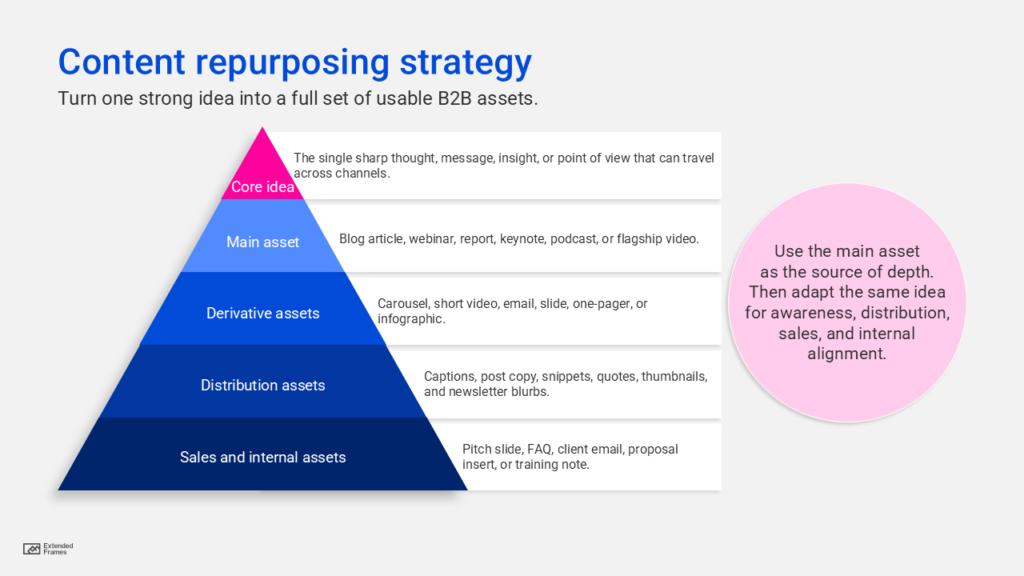
The core idea is the source. The main asset gives it depth. Derivative assets make it easier to consume. Distribution assets help it travel. Sales and internal assets make it useful beyond marketing.
For B2B companies, the best repurposed content often supports sales conversations, client education, onboarding, proposal development, and internal alignment. A strong blog should not live only on the blog. It should feed the full communication system.
A simple content repurposing workflow
Here is a simple five-step process.
1. Capture the core idea
Write the idea in one sentence.
Example:
“B2B teams can get more value from every strong idea by planning the blog, social, video, presentation, and sales versions together.”
Then write the reader problem:
“Teams feel pressure to publish often, but they do not have enough time, budget, or creative capacity to create fresh content for every channel.”
Then write the business link:
“Extended Frames helps teams turn ideas into clear, polished, reusable assets across decks, videos, and marketing materials.”
That gives the content a spine.
2. Build the main asset
The main asset should carry the full thinking.
For this topic, the main asset is a blog article. For other ideas, it could be a webinar, whitepaper, video, or presentation.
The main asset should include:
- The problem
- The reason it happens
- The framework
- Examples
- Mistakes to avoid
- A clear next step
Google’s guidance on helpful content is useful here. It recommends creating reliable content for people, not content built mainly to manipulate search rankings. That means the article should answer the actual reader problem with enough depth, clarity, and practical value.
3. Extract the strongest parts
After the main asset is drafted, mark the parts that can travel.
What to look for:
- Strong opinions
- Useful lists
- Simple frameworks
- Before-and-after examples
- Practical checklists
- Visual explanations
- Short phrases that can stand alone
- Sales-relevant insights
For example, this article can produce a carousel around the repurposing pyramid, a short video around the “weak idea” warning, and a sales slide around the “one idea, many assets” model.
4. Adapt for each channel
Each channel has a different job.
A LinkedIn post should start with a strong observation. A carousel should move one idea forward slide by slide. A short video should make one point fast. An email should give a reason to click. A sales slide should help someone explain the idea in a meeting.
Sprout Social’s social media guidance recommends aligning content goals with wider business goals and building a calendar that makes execution easier. That is important because repurposing should support a clear outcome, not fill empty posting slots.
5. Measure and improve
A content repurposing strategy should be measured by more than views. But also, on these points:
- Blog traffic
- Search impressions
- LinkedIn saves
- Carousel completion
- Video retention
- Email click-through
- Sales team usage
- Proposal response
- Lead quality
- Client questions generated
B2B content should create useful signals. A quiet post that brings one qualified enquiry may be more valuable than a viral post that attracts the wrong audience.
The repurposing checklist
Use this checklist to help you get started before publishing your idea.
Core idea
- Is the idea clear in one sentence?
- Is it specific to your audience?
- Does it connect to a real business problem?
- Does it include examples or proof?
- Can it be visualized?
Main asset
- Does the article, video, deck, or report explain the idea fully?
- Does it answer the reader’s question?
- Does it include a clear next step?
- Does it include useful internal links?
- Does it support search intent?
Repurposed assets
- Can the idea become a carousel?
- Can it become a short video?
- Can it become a slide?
- Can it become an email?
- Can it become a checklist?
- Can it become a sales asset?
- Can it become a follow-up post?
Brand consistency
- Are the visuals aligned with brand guidelines?
- Are the headlines written in the same voice?
- Are charts, icons, and layouts consistent?
- Does each format feel native to the channel?
- Can the team reuse the asset later?
Measurement
- What should this asset achieve?
- Which channel will be measured?
- What counts as success?
- Who will review the performance?
- What will be improved next time?
Where AI can help and where human judgment still leads
AI can help with transcription, summarizing, first-draft outlines, clip selection, caption drafts, and format variations. That can save time.
Human judgment still needs to lead the strategy.
A B2B team should decide what the idea means, who it serves, how it connects to the business, what proof supports it, and what the final asset should make someone understand or do.
Content Marketing Institute’s 2026 report found that strategy refinement was the biggest driver behind improved B2B content strategy effectiveness. Tools helped, but sharper planning played the bigger role.
A content repurposing strategy gives B2B teams a better way to use their strongest ideas. It helps marketing publish with more consistency. It helps sales explain ideas with better assets. It helps leadership build authority from practical thinking. It helps design teams create systems instead of one-off visuals.
The best place to start is choose one strong idea. Write the main article. Pull out the strongest sections. Turn them into a carousel, short video, email, sales slide, and checklist. Keep the message consistent. Adapt the format for each channel. Measure what worked.
One serious idea can travel far when it is planned well.
If your team has strong ideas sitting inside rough decks, old webinars, campaign folders, reports, or founder notes, Extended Frames can help shape them into clear, polished, reusable assets across presentations, videos, and creative design. Explore our creative consulting and design support to turn your content into assets your team can use.