

An executive audience is usually deciding, so executive storytelling in presentations has one job: move a decision forward with clarity, evidence, and momentum.
The executive way to tell a story is to start with the answer, earn it with evidence, and make the next step feel inevitable. This approach closely mirrors the “answer-first” logic used in executive communication frameworks like the Minto Pyramid (often taught in consulting contexts).
This guide gives you a practical system for executive storytelling in presentations, including structures, slide templates, charts, and checklists you can reuse.
What executives actually “Buy” when they listen
They’re listening for:
| Executive lens | What they’re silently asking | What your story must deliver |
|---|---|---|
| Decision | “What are you asking me to approve?” | A clear ask and success criteria |
| Trade-offs | “What are we giving up?” | Options and consequences |
| Risk | “What could break?” | Risks and mitigations |
| Confidence | “Do I believe this?” | Evidence and assumptions |
| Execution | “Will this happen in the real world?” | Owners, milestones, and dependencies |
This is why HBR’s advice on presentation-as-story works best when the “story” creates tension between the status quo and a better way, then resolves it with action.
Executive storytelling in presentations: The “Decision-First” structure
Think of your talk as a decision memo, with narrative flow.
The Decision-first story spine
- Answer (what you recommend)
- Because (the 2–3 reasons that matter most)
- Proof (the evidence behind those reasons)
- Risks (what could go wrong and how you’ll handle it)
- Plan (what happens next, who owns what, by when)
This maps cleanly to the Minto Pyramid idea: lead with the conclusion, support with key arguments, then details.
Mini-chart: “How exec attention behaves”
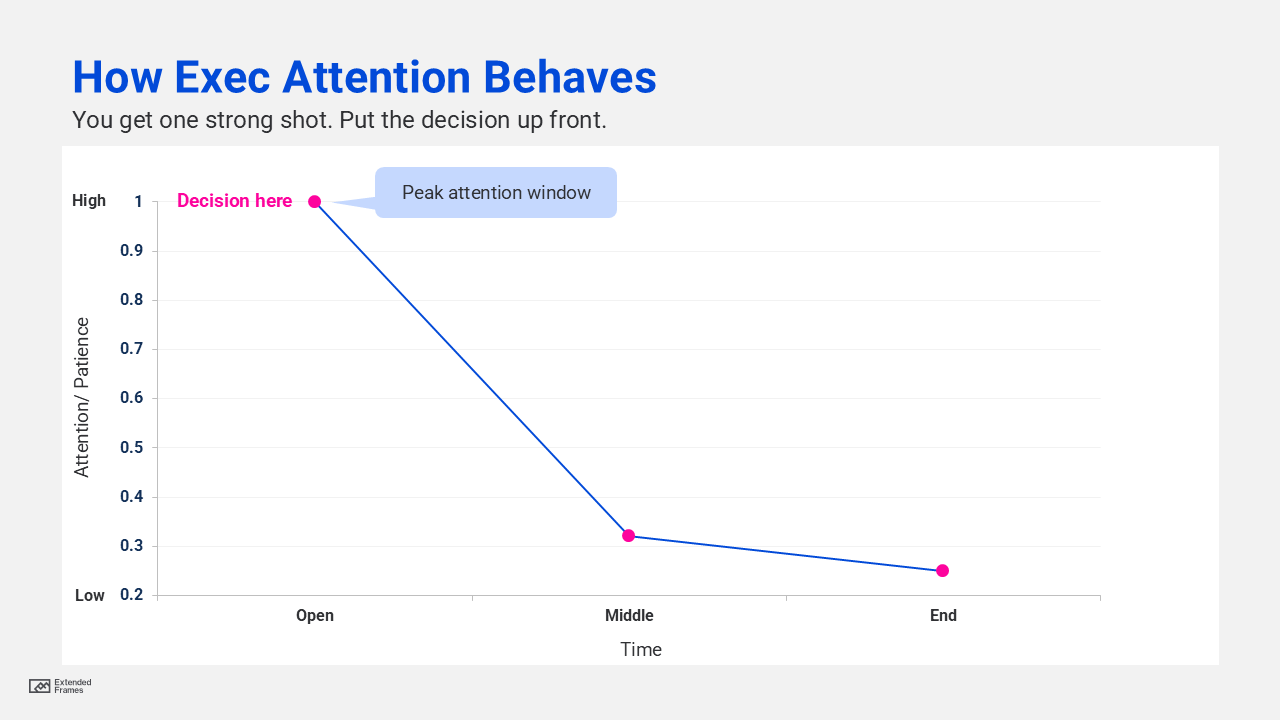
So put the decision where attention is highest: up front.
The Sparkline method
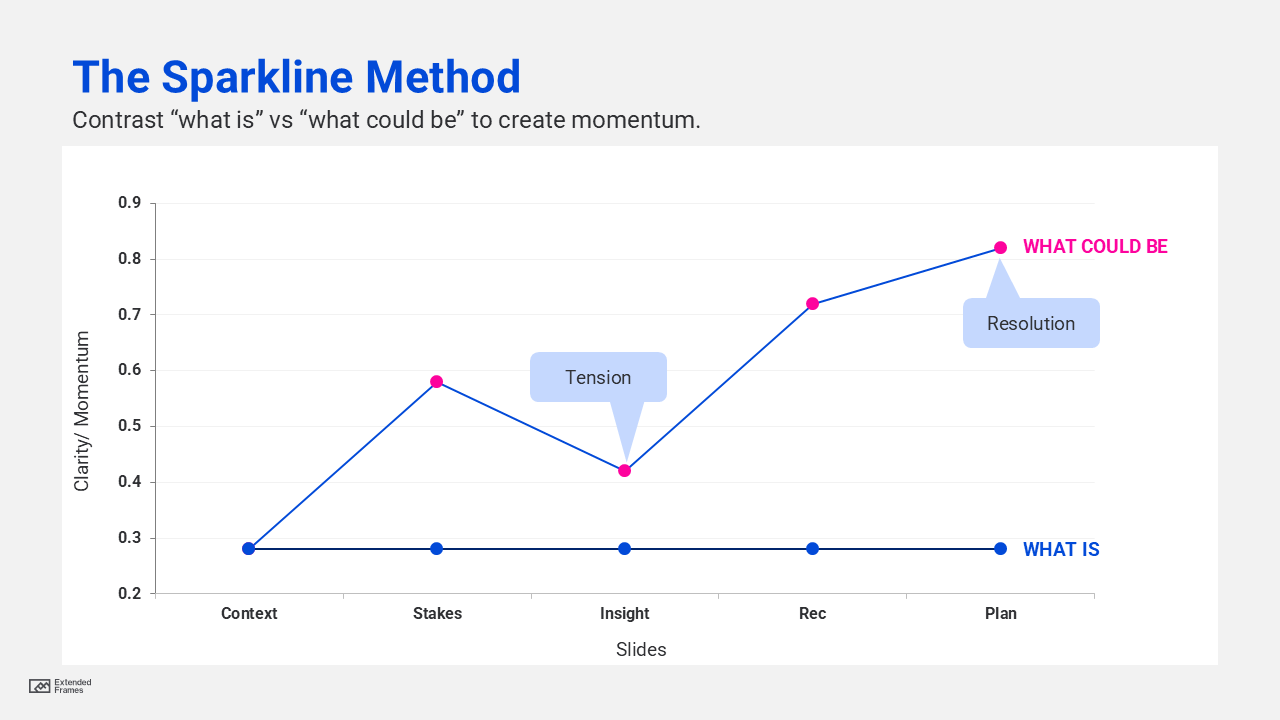
Nancy Duarte’s “sparkline” concept is powerful in executive rooms because it keeps the narrative moving: contrast what is vs what could be repeatedly, so the audience feels progress, not a report-out.
Sparkline chart
How to use it on slides:
- Every “problem” slide should be paired with a “lever/ outcome” slide.
- Every “risk” should be paired with a “mitigation and decision gate.”
- Every “data” slide should end with “therefore we will…”
Executive storytelling in presentations: a slide-by-slide blueprint
Use this 10-slide structure when you need a boardroom-ready flow.
| Slide | Title | Purpose | A strong headline sounds like… |
|---|---|---|---|
| 1 | Executive summary | Answer-first | “Approve X to achieve Y by Z.” |
| 2 | Why now | Create urgency | “Costs/ risks changed in Q3; inaction is expensive.” |
| 3 | What we learned | Insight | “The real constraint is ____ (not ____).” |
| 4 | What matters | Decision criteria | “We’re optimizing for speed and reliability, not breadth.” |
| 5 | Options | Show trade-offs | “3 paths; only 1 hits timeline without new headcount.” |
| 6 | Recommendation | Make the call | “We choose Option B for these 3 reasons.” |
| 7 | Evidence | Earn belief | “Leading indicators support this direction.” |
| 8 | Risks and mitigations | De-risk | “Top 3 risks and what we’ll do if they trigger.” |
| 9 | Plan and owners | Make it real | “Milestones, owners, decision gates.” |
| 10 | The ask | Close the loop | “Decision required today and next step.” |
If you want an extra layer of executive rigor, add an appendix for “deep detail”, so the main story stays clean.
Data storytelling
Executives looks for meaning and implication. A reliable pattern:
The 3-line script for any data slide
- What it shows (plain language)
- What it means (the insight)
- What we do (the action)
This aligns with cognitive principles behind learning from words and visuals, people process information across channels and have limited capacity, so clarity beats volume.
Turn charts into decisions
| If you use… | Headline should answer… | End with… |
|---|---|---|
| Trend line | “Up or down, and why it matters now?” | “So we will…” |
| Bars | “What’s biggest/ most urgent?” | “Priority is…” |
| Funnel | “Where are we losing value?” | “Fix step ___ first.” |
| Waterfall | “What’s driving the change?” | “Pull lever ___.” |
Rule: If the slide can’t be summarized in one sentence, it’s not an executive slide yet.
Why stories persuade and how to stay credible
Narratives can increase engagement and shift attitudes when people become “transported” into a story world, research in psychology and communication has explored this as a mechanism behind narrative impact.
But in executive rooms, persuasion must be auditable.
Executive credibility formula:
- Story opens attention
- Evidence earns trust
- Risks demonstrate maturity
- Plan proves feasibility
That’s how executive storytelling in presentations stays compelling without sounding like marketing.
Executive language upgrades (before/ after)
| Before (sounds soft/ salesy) | After (executive/ decision-first) |
|---|---|
| “We’re excited to share our vision…” | “Today’s decision: approve X so we can deliver Y by Z.” |
| “Let me walk you through the deck…” | “I’ll start with the recommendation, then the three reasons, then the proof.” |
| “This is a game-changer.” | “This reduces cycle time by removing ___ and introduces these trade-offs: ___.” |
Executive storytelling in presentations: A one-page checklist
Decision
- Ask is on slide 1
- Decision criteria are explicit (time, cost, risk, quality)
Narrative
- “Why now” is specific
- Options are real and comparable
- Recommendation has 2–3 reasons (not 10)
Evidence
- Each reason has proof
- Each chart has a takeaway headline and “so what”
Risk
- Top risks are named
- Mitigations include triggers and fallback plans
Execution
- Owners and milestones exist
- Next step is calendar-ready (“Approve by Friday”)
Conclusion
In executive rooms, attention drops fast and skepticism is healthy. That’s why the most effective decks don’t “build up to” the point, they lead with the decision, then earn agreement with a tight chain of logic.
Use the Sparkline Method to keep momentum: clearly contrast “what is” with “what could be”, then close the gap with evidence, risks, and a feasible plan. When your charts and headlines end with “so we will…”, the room moves from discussion to alignment, and from alignment to action.
Bottom line: Start with the answer. Prove it. De-risk it. Make the next step inevitable.