

B2B marketing collateral grows one request at a time. Sales wants a new presentation for an upcoming meeting. Product marketing needs a solution brief and so on, while another team asks for a customer story in PDF format.
Each request is reasonable. Six months later, the company has dozens of files, several versions of the same message, and salespeople still building their own slides.
The difficulty is deciding which materials are genuinely needed, what information they should contain, and whether something useful already exists.
For B2B teams, that decision deserves as much attention as the design and production work that follows.
What B2B marketing collateral needs to accomplish
Marketing collateral includes brochures, presentations, product sheets, case studies, reports, videos, and other materials used to explain or promote a company’s products and services. Some support broad marketing activity; others address specific questions during a purchasing decision.
A potential buyer researching software may want to understand integration requirements before speaking with sales. Someone preparing an internal business case may need costs, expected benefits, and implementation responsibilities.
The salesperson supporting those conversations needs reliable information that can be located and shared without recreating it for every opportunity.
Research reinforces the importance of serving both groups. Gartner’s March 2026 survey found that 67% of surveyed B2B buyers preferred a rep-free experience. Meanwhile, the 2026 6sense Buyer Experience Report found that 91.4% of buying groups had already ranked their vendor shortlist before contacting sellers.
Neither finding proves that a particular document will influence a purchase. They do indicate that buyers form opinions and work through decisions before sales has an opportunity to explain everything.
That makes clear, accessible, and consistent information especially important.
Choose B2B marketing collateral around the buying question
A familiar approach to collateral planning is to build a standard library: company brochure, sales deck, product sheet, customer case study, whitepaper, and perhaps a video.
The problem with that approach is the assumption that every B2B company needs the same collection.
A professional services business selling long-term consulting engagements faces different buyer questions from a software provider selling a standardized subscription. The first may need to explain delivery responsibilities and engagement scope. The second may spend more time answering questions about integration, security, and product capabilities.
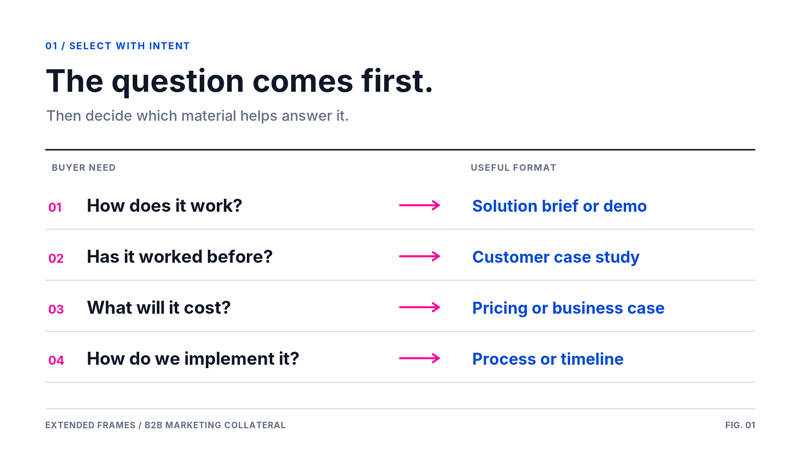
The buyer’s unresolved question should influence the asset before the team commits to a format.
Consider the following illustrative planning examples.
| Buyer or sales need | Collateral worth considering | When to skip or reuse |
|---|---|---|
| Understand the offering | Solution brief or clear service page | Skip a separate brochure if the existing page answers the questions |
| Evaluate a specific capability | Product sheet, technical explainer, or demo | Avoid repeating generic company information |
| Assess implementation risk | Customer case study, delivery timeline, or process diagram | Reuse approved project evidence where suitable |
| Justify the investment internally | Business-case summary, cost explanation, or ROI model | Avoid unsupported ROI projections |
| Compare alternatives | Factual comparison sheet or internal sales battlecard | Skip when differentiation cannot be supported |
| Present a recommendation to stakeholders | Shareable executive summary or focused presentation | Avoid sending an entire pitch deck when a short summary will suffice |
Illustrative recommendations, not a measured ranking of collateral effectiveness.
This approach also helps prevent unnecessary production.
If the answer already exists in a well-maintained product page, building a separate PDF may introduce another document that needs updating. However, if buyers routinely forward information to colleagues who cannot attend a sales call, a concise standalone document may be worthwhile. The decision depends on how the information will be used.
What sales actually needs from marketing
Sales teams may request new materials because an existing document is difficult to find, too broad for a particular conversation, or missing information that prospects repeatedly ask for.
Those situations require different responses. If a representative regularly removes half the slides from a standard company presentation, the team may need a shorter modular deck. If sales keeps rewriting an explanation of implementation costs, the approved content may be incomplete. If representatives build different versions of the same product comparison, the problem could be ownership and consistency.
A new design will not automatically resolve any of those issues.
Ask sales about the conversations that are difficult to advance
Instead of asking representatives which collateral formats they want, review a small sample of actual sales situations.
Look at recent opportunities that progressed, stalled, or were lost. Ask what prospects wanted to understand, which documents were shared, and where the available material fell short.
An illustrative example: A B2B technology provider discovers that prospects frequently ask how long an implementation takes and which internal resources they must provide.
The marketing team initially proposes an explainer video introducing the product’s benefits. But the questions are operational. A documented implementation timeline, supported by accurate responsibilities and dependencies, would address them more directly. A short video might still help buyers understand a complicated process, but the underlying information needs to exist first.
This distinction saves production effort and gives the design team a clearer brief.
Remember the colleague who was not in the meeting
An executive may attend a demonstration, understand the proposed solution, and then need to explain it to finance, procurement, or another department.
Those stakeholders may never see the original presentation.
The 2026 6sense research describes buying groups deliberating over both the value of a purchase category and their preferred vendor.
One implication is that sales collateral should remain understandable when it moves beyond the original conversation.
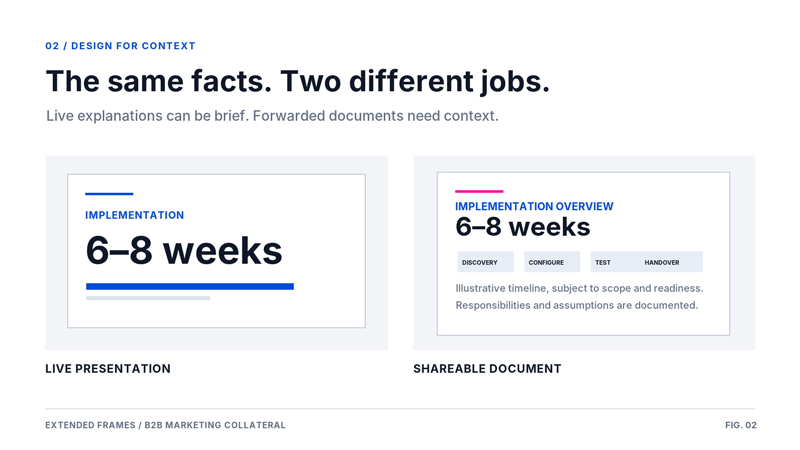
A standalone summary needs enough context to explain what is being proposed, why its important, what evidence supports it, and which assumptions or costs remain unresolved.
An slide containing a percentage and a customer logo may work during a live explanation. Forwarded without the speaker’s context, it could leave the next reader with more questions.
What to create first, and what can wait
There is no universal order of production. However, a relatively small collection of accurate materials can often support several different conversations.
A clear offering explanation and reusable sales presentation
A company should be able to explain whom it serves, the problems it addresses, how its solution works, and what a buyer can reasonably expect.
For a complex offering, this may require a presentation that sales can adapt. A service with a straightforward scope might be better explained on a webpage and through a concise downloadable brief.
When presentations are necessary, reusable sections are generally easier to maintain than multiple independently edited decks.
Design also affects how well a presentation works in different settings. A slide built for a live conversation may need additional labels or explanatory context before it can be emailed to someone who was absent.
Customer evidence that answers a specific concern
Customer case studies become especially useful when buyers need evidence that a supplier has handled comparable situations.
A recognizable logo or positive testimonial can contribute credibility, but buyers may still need to know what was delivered, which challenges occurred, and how the outcome was measured.
Extended Frames’ guide on turning B2B customer case studies into sales assets explores how approved evidence can support different buyer questions without overstating the results.
Before producing several variations of a customer story, establish whether the underlying evidence is complete enough to support them.
Technical, commercial, and implementation information
For complex purchases, the least glamorous materials may be among the hardest to do without.
Security documentation, pricing explanations, technical specifications, implementation requirements, and procurement responses can become essential during evaluation.
Marketing should work with the relevant subject-matter owners to make these materials understandable and consistent. It should not independently certify technical capabilities or commercial terms.
A detailed whitepaper may be appropriate when original research helps buyers understand a substantial problem. Extended Frames’ article on designing B2B whitepapers worth reading explains why the strength of the research and argument should determine the document’s structure.
Without meaningful research, a shorter educational resource may be a more sensible investment.
What to skip, consolidate, or stop producing
One of the more difficult marketing decisions is choosing not to commission something.
A new company brochure may feel overdue because the previous one is several years old. Before commissioning a replacement, check whether customers still need that format and which information has become inaccurate.
Similarly, a lengthy capabilities deck may have little value if representatives consistently use only a handful of slides. Updating those sections and maintaining a reusable slide library could be more practical than redesigning the entire presentation.
Consider holding off on:
- A second document that repeats information already available in a maintained source.
- A case study without sufficient customer-approved evidence.
- An ROI infographic based on assumptions presented as measured outcomes.
- A long report assembled from familiar industry observations without meaningful original findings.
- Multiple collateral variations with no owner responsible for future updates.
These are editorial and operational recommendations, not claims that the formats themselves are ineffective.
A brochure remains useful when an event, distributor, or specific buyer audience needs one. A detailed report can provide substantial value when the research warrants it. The question is whether the proposed asset offers something the intended audience cannot already obtain conveniently.
The hidden cost of maintaining more collateral
The initial design cost is only part of an asset’s lifetime expense.
A product sheet may need changes when capabilities or pricing are revised. A customer story can require updated permissions. An executive presentation may contain figures that were accurate when produced but no longer reflect the business.
Every additional version increases the number of places where outdated information can remain.
Gartner’s 2025 buyer survey found that 69% of respondents reported inconsistencies between supplier websites and information provided by sales representatives.
The survey does not establish that poorly managed collateral caused those discrepancies. Nevertheless, keeping approved information consistent across channels is a reasonable response.
Build from approved information, then adapt the format
Consider a product company preparing materials for a new offering.
The marketing team needs a product page, sales presentation, downloadable brief, and competitive comparison.
Instead of independently writing each document, the company can maintain an approved record of product capabilities, limitations, commercial information, and supporting evidence.
Each format can then use the relevant parts of that information.
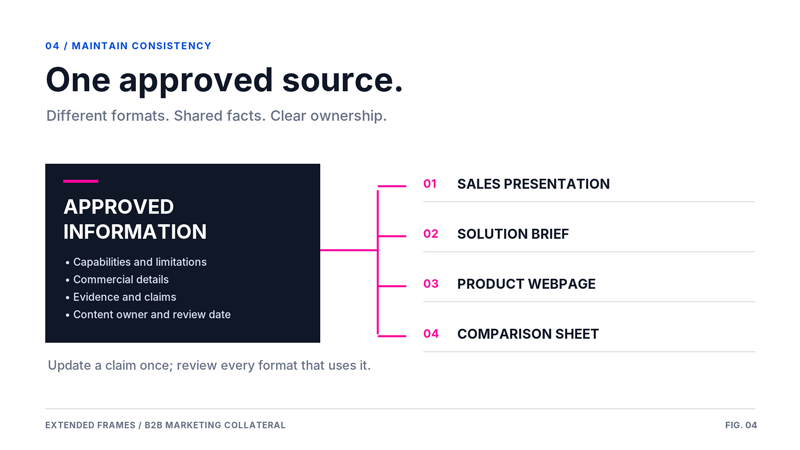
This reduces the opportunity for contradictory claims, although it still requires review when individual formats are updated.
A simple asset register can identify the audience, approved version, owner, last review date, and source of important claims. There is little reason to purchase a sophisticated content management platform before establishing who is responsible for maintaining the information.
How to know whether collateral deserves continued investment
Website traffic, downloads, and document views can indicate interest. They do not establish whether a sales asset helped a buyer reach a decision.
For materials used directly by sales, examine whether representatives can find the right document, whether they actually use it, and whether recurring buyer questions are being answered.
Start with a manageable review. Select several active and recently completed opportunities, identify the materials used, and compare them with the requests sales made during those conversations.
An asset might receive relatively few views yet remain valuable because it addresses a recurring procurement concern. Another may attract significant traffic but contribute little to the buying questions the team needs to resolve.
Where CRM data and content-sharing records are available, examine patterns across opportunities. Avoid attributing a win or a faster sales cycle to one document merely because it was shared.
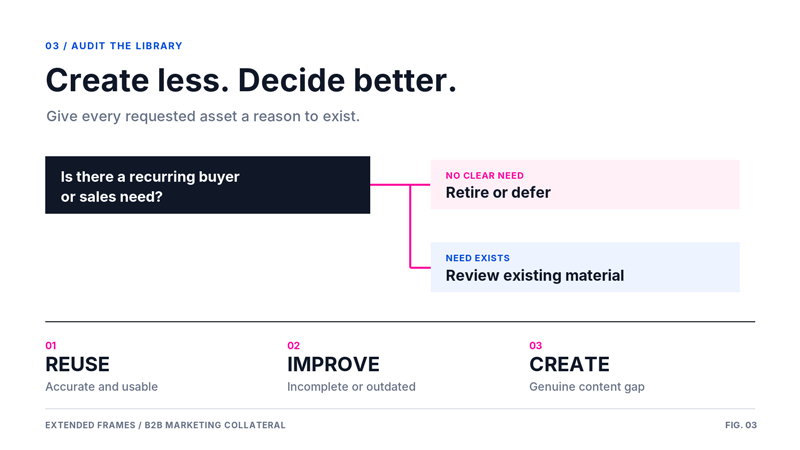
The assessment should lead to decisions: maintain an important asset, revise an unclear one, consolidate duplicates, or retire something that no longer has an identifiable purpose.
Provide the design with a more specific problem to address
Once the purpose and evidence are established, design can make the material easier to understand and reuse.
A comparison may benefit from a table. A complex proposal might require a concise executive presentation. Some information will be clearest as well-structured text. The format should follow the information and the circumstances in which someone needs to use it.
That also means designers should know whether a document will be presented, emailed, printed, or adapted by sales. These details influence layout, information hierarchy, file format, and the amount of context each page must carry.
Build a smaller, more dependable collateral library
Before approving the next collateral request, examine what the company already has and what buyers still struggle to understand.
There may be material worth preserving, accurate content that needs a better structure, or a missing explanation that deserves priority over another campaign asset.
B2B teams can make better production decisions when marketing and sales agree on the questions their materials need to answer and who will maintain the answers.
If your company has existing briefs, presentations, case studies, or sales materials that need clearer structure and consistent design, Extended Frames’ marketing and brand design services can help develop and refine collateral for the way your team actually uses it.