

A creative agency retainer vs project-based design arrangement can look like a straightforward budget decision. Pay a monthly fee for ongoing creative support, or commission individual projects as they come up.
For a B2B marketing team, the implications go further. A product launch might need a sales presentation, campaign graphics, an explainer video, and several last-minute revisions. Three months later, the same team might need little beyond updating existing materials.
Committing to a monthly retainer could secure dependable creative support during the launch. It could also leave part of that budget unused afterward.
So how do you decide?
Get started with the work your team needs, how it moves through approvals, and whether a predictable relationship would solve problems you’re currently paying to manage.
What Are You Paying for With Each Arrangement?
Project-based design means commissioning a defined piece of work for an agreed fee, usually with specified deliverables, deadlines, and revision terms.
A B2B team might use this arrangement for a new PowerPoint template, corporate presentation redesign, whitepaper, or product explainer video.
Once the agreed work is delivered and approved, the engagement ends unless another project is commissioned.
A creative agency retainer is an ongoing arrangement in which a company pays a recurring fee for agreed services, deliverables, or production capacity.
That distinction is important because retainers are structured differently.
Some provide a fixed number of design hours. Others allocate production capacity, defined monthly deliverables, or ongoing creative direction. Priority access may be included, but the agreement should say what that means.
A retainer does not automatically guarantee unlimited design work, immediate turnaround, or access to every specialist an agency employs.
The ANA and 4A’s joint guide to agency compensation addresses the different models available to advertisers and agencies. There is no single compensation arrangement appropriate for every type of assignment.
Creative Agency Retainer vs Project-Based Design: Where Each Works Best
The clearest distinction emerges when you look at the pattern of work rather than the agency’s price list.
| Consideration | Project-based design | Creative agency retainer |
|---|---|---|
| Workload | Defined assignments | Recurring creative needs |
| Budget | Agreed cost per project | Recurring budget commitment |
| Scheduling | Availability negotiated per assignment | Capacity or priority defined by agreement |
| Scope changes | Usually require revised estimates | Managed within agreed capacity or scope |
| Brand familiarity | May require briefing for new engagements | Can improve through continuing collaboration |
| Unused capacity | No standing allocation to use | May expire unless carryover is agreed |
| Best fit | Specific deliverables and deadlines | Ongoing production with sufficient demand |
These differences describe typical arrangements. The contract determines the actual service.
When project-based design makes more sense
Imagine your marketing team needs a 30-slide investor presentation for an upcoming funding round.
The content is approved. The deadline is known. You need a designer to restructure the slides, improve data visualization, and deliver an editable PowerPoint file.
A fixed-price project is a sensible arrangement. You can define the number of slides, expected design complexity, revision rounds, and delivery date before commissioning the work.
There’s little reason to purchase ongoing capacity if the team has no immediate work planned after the presentation.
Project-based agreements also give B2B teams flexibility when specialist requirements change. A complex animation project, for example, may require different skills from a sales enablement presentation.
The weakness appears when seemingly separate projects start overlapping.
A launch presentation needs updating. Sales requests three variations. Product marketing needs matching graphics. Another department asks for an executive summary.
Each request may require fresh estimates, scheduling, and approval. At that point, individually purchasing every assignment can introduce administrative work that the original project budget never captured.
The ANA and 4A’s guidance for project-based agency reviews recommends matching the selection process to the size and complexity of the assignment. A small creative project should not require an unnecessarily elaborate procurement exercise.
When a creative retainer earns its place
Consider a B2B software company with a continuing schedule of webinars, product updates, campaigns, and sales enablement work.
Its internal marketing team handles messaging and campaign planning but regularly needs outside design and video support.
The creative work doesn’t necessarily arrive in equal quantities every week. There is, however, enough recurring demand to justify allocating production capacity.
A retainer can make sense here. The agency becomes familiar with the brand’s presentation system, messaging, review requirements, and recurring deliverables. The marketing team can plan work against agreed capacity rather than negotiate every assignment independently.
Continuity can reduce repeated briefing and onboarding effort, although the amount saved will depend on how well the relationship is managed.
But the arrangement still needs someone on the client side to prioritize requests.
A retainer with five departments submitting competing urgent briefs can become difficult to manage, even when the agency has sufficient design capability.
Paying for availability doesn’t resolve competing priorities.
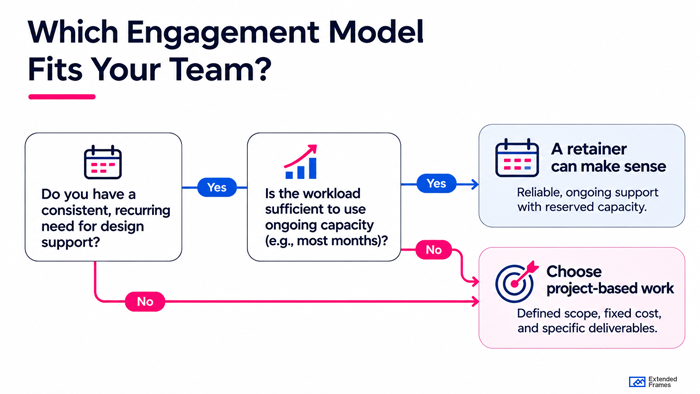
The Cost Comparison Needs More Than a Monthly Fee
It’s tempting to calculate whether a retainer is worthwhile by comparing its monthly price against the combined cost of individual projects.
That is useful, but incomplete. Consider the following hypothetical comparison.
A B2B marketing department expects to spend $3,000 per month on external design projects. An agency offers a $2,500 monthly retainer covering a comparable mix and volume of work.
| Illustrative six-month comparison | Project-based | Retainer |
|---|---|---|
| Monthly budget | $3,000 | $2,500 |
| Six-month commitment | $18,000 | $15,000 |
| Difference | $3,000 less |
Illustrative figures only. These are not market averages or Extended Frames quotations. The comparison assumes equivalent scope, quality, and delivery requirements.
On paper, the retainer saves $3,000. But suppose the team uses only half of the available capacity for two of those months, and unused capacity expires.
The savings become harder to justify.
Now consider the opposite situation. The team uses its monthly allocation consistently, receives agreed priority scheduling, and spends less internal time preparing separate procurement requests.
The retainer may offer better overall value, even if the direct design cost is similar.
A useful comparison therefore considers:
- Utilization: How much of the purchased capacity will the team realistically use?
- Coordination: How much employee time goes into briefing, estimating, approving, and restarting separate projects?
- Availability: What does the team gain from having agreed production capacity when deadlines overlap?
- Overflow: What happens when demand exceeds the monthly allocation?
For a more reliable estimate, examine the previous three to six months of creative requests. Record the work completed, outside expenditure, rush charges, and time spent managing suppliers.
Then compare that history with a proposed retainer’s actual scope. This approach is more defensible than assuming a fixed number of monthly deliverables automatically makes a retainer cheaper.
A Retainer Can Hide an Internal Planning Problem
A team that constantly needs urgent creative work may appear to be an obvious candidate for ongoing support.
Yet recurring emergencies do not necessarily indicate recurring production demand. Consider a marketing department that sends requests only after campaign content has been delayed, stakeholder feedback has accumulated, or a presentation deadline is approaching.
Adding an agency retainer could improve access to designers. It won’t automatically correct how briefs are prepared or approvals are handled.
An agency can reserve time for a presentation scheduled next Thursday. It cannot guarantee that the presentation will be finished if six stakeholders submit contradictory feedback on Wednesday evening.
This distinction is important when evaluating what kind of help the team needs. For example, a recurring backlog of outdated decks, inconsistent templates, and duplicated assets may call for an initial cleanup project before ongoing support.
Our article on creative debt and the problems caused by outdated design assets explores how those issues accumulate across teams.
Similarly, repeated launch delays may indicate weaknesses in the way creative work moves through product marketing. The article on product marketing operations and creative execution examines that challenge in more detail.
Editorial interpretation: Before signing a retainer, identify whether the constraint is insufficient production capacity, poor internal coordination, or both. They require different solutions.
The Hybrid Approach Deserves More Attention
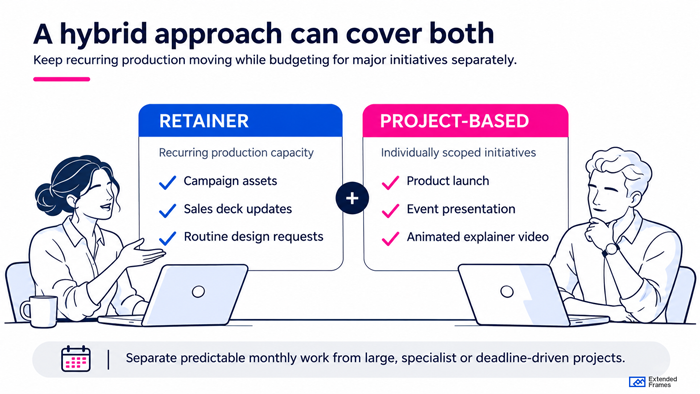
B2B marketing work rarely falls neatly into one purchasing category. Some requirements are continuous. Others are substantial, specialized initiatives with clear boundaries.
An agency relationship can accommodate both. Promethean Research’s 2025 Digital Agency Industry Report reports that 88% of agencies in the underlying surveyed dataset offered both project-based and retainer engagements.
That figure describes agency offerings, not proof that hybrid arrangements deliver better results for clients. Still, it shows that using more than one pricing model is well established.
Consider a B2B company preparing for an annual customer conference.
The company could commission the event’s main presentation, animated opening video, and visual system as a defined project.
Its recurring sales deck updates, campaign graphics, and smaller creative requests could remain within an ongoing monthly arrangement.
This separates major production commitments from routine demand.
It also makes it easier to determine which work needs separate budgeting, specialist resources, or a longer production schedule.
For teams whose requirements change considerably throughout the year, this arrangement may be more appropriate than trying to fit everything into one monthly fee.
What Should Be in a Creative Agency Retainer Agreement?
A monthly fee means very little until both parties understand what can be requested and how the work will be managed.Before signing, clarify the following.
Scope and capacity. What services are included? Is the allocation based on hours, deliverables, or another capacity measure? Does video production consume the same allocation as presentation design?
Turnaround and prioritization. When does the delivery clock begin? Are urgent requests included? How many assignments can run simultaneously?
Revisions and additional work. How are corrections distinguished from changes in scope? What happens when requests exceed the agreed capacity?
Unused capacity and cancellation. Does unused capacity carry over? How much notice is required to end or renew the arrangement?
Ownership and handover. Will the client receive editable source files, appropriately licensed assets, and any agreed templates? What intellectual property rights transfer, and when?
Again, the 4A’s guidance on ownership of agency work reinforces the importance of agreeing ownership and usage terms rather than leaving them ambiguous.
For B2B teams handling confidential product information or unreleased financial material, information security, confidentiality, and access controls should also be documented.
Finally, agree how the relationship will be reviewed. A simple monthly discussion covering completed work, unused capacity, upcoming demand, and delivery issues can reveal whether the original arrangement still makes sense.
How to Make the Decision Without Guessing
If your B2B team is considering a retainer, the next step should be a workload review rather than another round of agency proposals.
Look at the last six months of design requests. Separate the work into recurring production, major one-off assignments, and unexpected requests. Identify which deadlines were missed because of insufficient design capacity and which were delayed by incomplete content or approvals.
Then examine the next quarter’s marketing calendar. If there is a dependable stream of work that consistently needs outside production support, request a retainer proposal with clearly defined capacity and turnaround terms.
If the workload consists mainly of occasional, substantial deliverables, commission those projects individually.
Where the picture is uncertain, start with a defined project. Use it to evaluate the agency’s communication, quality, responsiveness, and ability to work within your existing brand system before considering a longer engagement.
A retainer should earn its place in the marketing budget through reliable use and a better production process. If it cannot demonstrate either, the arrangement deserves reconsideration.
Finding the Right Creative Support for Your B2B Team
The decision between a creative retainer and project-based design should reflect the work your team expects to produce, the deadlines it must meet, and the level of ongoing support it can realistically use.
At Extended Frames, we support B2B teams with presentation design, marketing video production, and marketing and brand design through defined projects and ongoing engagements.
If you’re reviewing how to organize external creative support, explore our creative consulting approach. We can discuss your upcoming work, the production challenges you’re facing, and an engagement structure that makes sense for your team.