
B2B explainer video cost varies considerably, even when production companies are quoting for the same video length.
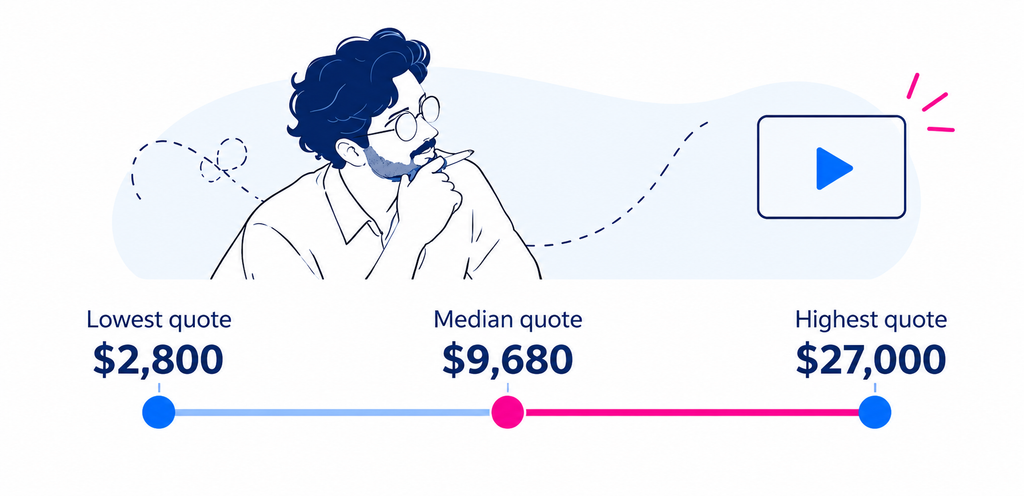
A published pricing study by Yum Yum Videos found quotations ranging from $2,800 to $27,000 for a custom 60-second animated explainer. That’s a substantial difference for a marketing team trying to establish a reasonable production budget.
The difference comes down to what the production includes: script development, visual direction, illustration, animation, revisions, and the people responsible for delivering the finished video.
Some clients need help developing the story from the beginning. Others already have an approved script, storyboard, or brand assets and only need a production partner to bring them to life.
Knowing what work remains is the starting point for understanding what you should pay.
B2B Explainer Video Cost: What Should You Budget?
There is no single industry-wide price for a B2B explainer video. However, published production-company research and advertised studio rates provide useful reference points.
In its 2026 explainer video pricing research, Yum Yum Videos reported contacting 125 production companies and animation studios. Of the 76 companies that responded, 61 provided usable quotations for a fully custom 60-second animated explainer.
The findings were:
| Pricing measure | Reported finding |
|---|---|
| Lowest usable agency quotation | $2,800 |
| Highest usable agency quotation | $27,000 |
| Median agency quotation | $9,680 |
| Average agency quotation | $11,420 |
| Median estimated production timeline | 7 weeks |
Source: Yum Yum Videos, September 2026. These are findings from a provider-conducted quotation study, not an independently audited industry-wide pricing survey.
The same company describes $8,000 to $25,000 as a typical price range for fully custom 60-second explainer videos produced by full-service video companies.
Published studio packages can also sit below that range.
For example, Gisteo’s public pricing lists a custom 60-second animated explainer at $4,000 for its full-service package and $3,500 when the client supplies an approved script with storyboard cues. Its expedited production package is listed at $5,000.
These examples establish two useful points.
First, custom animation is sold at substantially different prices across providers.
Second, comparing prices without examining production scope tells you very little about whether you’re receiving good value.
A lower quote may be appropriate when the creative direction is established and the work is relatively straightforward. A more expensive production may involve extensive original artwork, demanding animation, or considerable work developing the message.
The challenge is understanding which of those services your project actually needs.
What Actually Drives Explainer Video Pricing?
Scriptwriting and creative development
A studio receiving an approved script and detailed brief has less preliminary work than one starting with product documentation and an undeveloped idea.
For a technical B2B product, the early creative process may involve understanding the intended audience, reviewing product information, identifying the central message, and developing a script that can be explained visually.
That work affects what the animation team ultimately produces.
But there’s no reason to pay for a complete script-development process again if your team has already completed and approved it.
The production partner should assess the supplied content, clarify whether anything needs attention, and price the remaining responsibilities accordingly.
Animation style and visual complexity
Animation style influences the amount of artwork, preparation, and production work involved.
Motion graphics built around typography, icons, diagrams, and established brand assets can have different requirements from original character animation or detailed 3D visualization.
Within each style, complexity also varies.
An animation with original illustrations, detailed transitions, and extensive scene changes may demand more work than a simpler production using existing visual elements.
The decision should follow the information being explained.
For software or technical services, animated diagrams and interface elements can often communicate processes directly. Physical products may benefit from more detailed visualization when viewers need to understand how something is constructed or operates.
Adding visual complexity without a clear communication purpose increases the production scope without necessarily improving the explanation.
Video length and scene count
Production costs don’t always rise proportionally with video duration.
Some work, including project setup and visual direction, is required regardless of the finished length. Other tasks depend on the amount of artwork and animation in individual scenes.
That means a price-per-minute comparison can be misleading. Ask how the studio defines scenes, what level of customization is included, and whether the proposed duration is appropriate for the content.
A shorter video with elaborate animation can still require substantial production work.
Voiceover, sound, captions, and final formats
Audio production and delivery requirements can also affect the quotation.
Check whether the price includes voiceover recording, music licensing, sound effects, mixing, captions, and the final export formats.
Captions are particularly important for accessibility. The W3C’s guidance on captions explains their role in making prerecorded video content accessible.
If you need a website version, social media edits, alternate aspect ratios, or localized versions, establish those requirements before production begins.
They may involve work beyond exporting the same finished video into a different file format.
What If You Already Have the Script?
Having an approved script can reduce the production scope. But the amount you save depends on the studio’s pricing structure and what else your team provides.
Gisteo offers a useful published comparison. Its Just Animate! package is advertised at $3,500 for a custom 60-second animated explainer when the client supplies a fully approved script with storyboard cues.
Its Full-Service package is advertised at $4,000 and includes discovery and script development.
The difference between those advertised package prices is $500.
That is a specific provider’s price difference, not a standard discount that clients should expect from every animation studio.
It also highlights an important distinction: having a finished script doesn’t mean the video is ready for animation.
What the studio still needs to do
Even when a client supplies the script, the production process may still require the following work.
| Production stage | Work that may still be required |
|---|---|
| Script review | Checking narration timing and visual feasibility |
| Visual direction | Establishing how the script will be represented on screen |
| Storyboarding | Planning scenes, compositions, and transitions |
| Asset development | Preparing illustrations, diagrams, characters, and brand graphics |
| Animation | Creating motion and coordinating visual timing |
| Audio production | Recording voiceover, incorporating music, and mixing sound |
| Review and delivery | Managing revisions, final rendering, captions, and exports |
In Gisteo’s published example, the client-supplied-script package still includes a key-frame storyboard, voiceover, illustration, animation, music, and sound effects.
This helps explain why the advertised price difference between its packages is relatively limited.
A finished script and a production-ready project are different
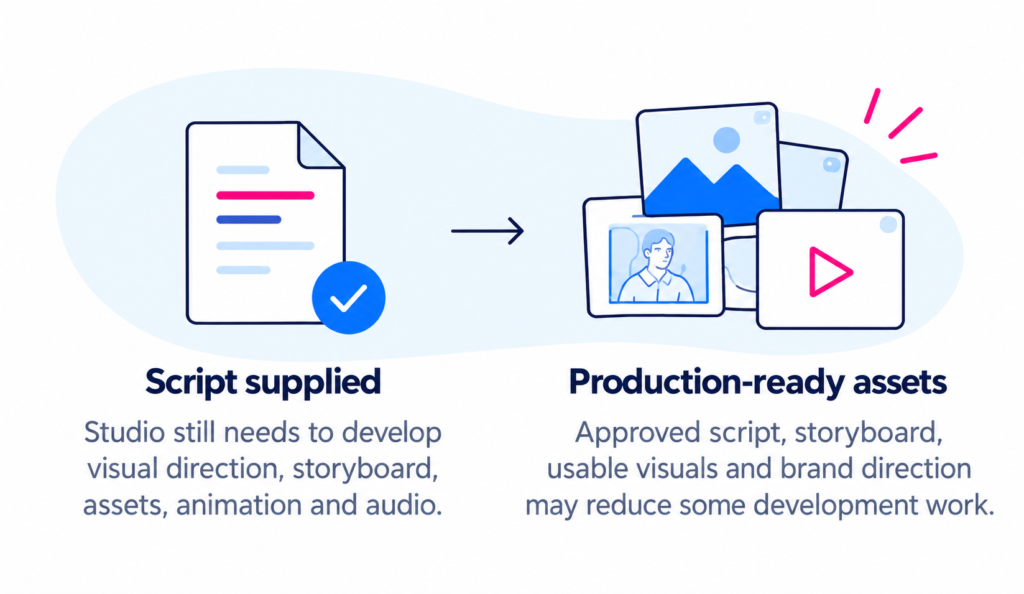
Supplying a narration document is useful, but the studio still needs to determine what viewers should see while each part of the narration is delivered.
A script accompanied by an approved storyboard provides additional direction.
If your team also supplies usable illustrations, approved visual treatments, brand assets, or prepared product footage, some creative-development and asset-production work may already be complete.
Whether this reduces the quotation depends on the condition of those materials and the studio’s workflow.
A storyboard prepared for an internal presentation may need redesign before animation. Existing illustrations may not be suitable for motion or the required screen formats.
The sensible approach is to have the studio review the actual materials before determining what can be reused.
When the approved script needs attention
An approved script may still present production difficulties.
Narration can be too dense for the intended duration. Technical descriptions may be difficult to illustrate. The script may introduce visual requirements that weren’t anticipated when the content was written.
A good production partner should identify these concerns before animation starts.
If the wording has already received internal approval, the studio should recommend changes for review rather than altering the content without authorization.
When requesting quotations, ask vendors to price the project based on your existing materials and identify any additional creative work separately.
This helps you understand what has already been completed, what remains, and what you’re paying the production partner to deliver.
The Costs That Can Appear After the Initial Quote
Even a clearly quoted production can become more expensive when the project changes. One source of additional work is revising previously approved content.
If a script is changed after the storyboard has been approved, the studio may need to update the scene sequence, artwork, animation, or recorded narration.
Changes become more complicated when work depends on content that is still evolving.
Product updates during production
Software companies should pay particular attention to interface stability.
If a video reproduces product screens and those screens change during production, affected scenes may require new assets or animation work.
When the interface is still evolving, a conceptual explainer may be more suitable than a detailed walkthrough.
A conceptual video can focus on the problem, the solution, and the intended business outcome without depending heavily on interface details.
A product walkthrough has different requirements because the viewer needs to see how the software works.
Our SaaS product demo video production guide explains those decisions in more detail.
Revisions, formats, and licensing
Before accepting a quotation, establish how revisions are handled.
Some studios include defined review rounds. Others offer revisions within specified production stages. Additional changes may be charged separately depending on the agreement.
Also clarify ownership of the finished video and access to editable project files.
For example, Gisteo states in its published pricing information that standalone projects normally include delivery of the finished video file rather than the editable source files. It offers source-file buyouts separately, starting at $500.
That’s a provider-specific policy, but it illustrates why ownership and future maintenance belong in the initial discussion.
For a B2B product video expected to remain in use as the offering develops, access to editable files and a clear update arrangement may be commercially important.
Where B2B Teams Should Spend More, and Where They Can Save
The best place to spend your production budget depends on what makes the product difficult to explain.
For a technically complex offering, the script and visual accuracy deserve close attention.
If an explanation depends on workflows, architecture, or product relationships, the diagrams and animation need to represent those details accurately.
More decorative animation may contribute little to that objective.
Existing creative assets can also reduce unnecessary work.
Approved illustrations, diagrams, brand graphics, and established motion treatments may provide useful starting material, provided they are suitable for the intended production.
This becomes especially relevant when a marketing team is producing several assets for the same launch.
As discussed in our article on product marketing operations and creative production, product information often needs to move across websites, presentations, videos, and sales materials.
Planning these requirements together creates opportunities to reuse approved messaging and visual assets.
There’s also a reason to be careful about reducing video length purely to lower the quote.
A homepage overview and a detailed technical demonstration have different communication requirements.
The appropriate duration depends on what the viewer needs to understand. Cutting necessary information can undermine the purpose of the video.
How to Compare Explainer Video Quotes Fairly
For a meaningful comparison, production partners need to receive the same brief.
Define your intended audience, key message, approximate duration, expected use, available assets, and delivery requirements.
Then compare the proposals against the work included.
| What to compare | What to clarify |
|---|---|
| Creative development | Is scriptwriting included? What happens if the script is already approved? |
| Storyboarding | Is a storyboard developed by the studio, supplied by the client, or adapted from existing material? |
| Visual production | How much original artwork and customization are included? |
| Animation | What level of motion complexity is covered? |
| Audio | Are voiceover, music, sound effects, and mixing included? |
| Revisions | What can be changed at each approval stage? |
| Deliverables | Which video formats, versions, and captions are included? |
| Ownership | Will you receive editable files, and what licensing conditions apply? |
| Future maintenance | How will updates to the video be handled? |
Ask each vendor to identify exclusions and additional costs that could apply.
Also review examples of work comparable to your own requirements.
A studio experienced in consumer advertising may produce excellent animation, but that portfolio alone doesn’t establish its ability to explain a technical B2B process.
Pay particular attention to how the team approaches scripting and storyboarding.
These stages establish what the finished video needs to communicate and how the explanation will unfold visually.
When those decisions are approved before animation begins, the production team has clearer direction and fewer unresolved questions.
Is a B2B Explainer Video Worth the Investment?
The value of an explainer video depends on its intended purpose and whether it helps achieve that purpose.
For a product website, it may be intended to help visitors understand the offering before requesting a demonstration.
For sales enablement, the goal may be to explain a capability before a detailed customer conversation.
An internal training video may be intended to make a process easier to understand and repeat.
Each requires different measures of success.
Website teams may examine engagement and qualified inquiries. Sales teams may evaluate whether a video is being used and whether it helps prospects understand the product. Training teams may assess comprehension and recurring questions.
None of these results should automatically be attributed to the video without appropriate evidence.
A high view count doesn’t establish that the content influenced a buying decision.
Before commissioning production, decide where the video will be used, what viewers should understand afterward, and how you intend to evaluate its contribution.
That gives the investment a defined purpose and makes the production requirements easier to prioritize.
A Sensible Budget Starts With a Clear Brief
Published production-company pricing shows substantial variation in the cost of custom animated explainers.
Those differences reflect different combinations of creative development, visual production, animation complexity, review responsibilities, and deliverables.
A company approaching a studio with an undeveloped idea has different requirements from one supplying an approved script, storyboard, and usable visual assets.
Both may need professional production, but the work involved is different.
Before approving a quotation, establish what has already been completed, what the studio needs to produce, and what will happen if the project changes.
At Extended Frames, we work with B2B teams on video projects that can begin with a rough idea, product brief, presentation, approved script, or existing creative materials.
Already have a script or planning a new explainer? Share your materials with us. We’ll help assess what’s ready, what needs further development, and the production scope required to turn it into a finished video.