

A B2B company publishes a customer case study announcing a successful implementation. The customer is recognizable, the testimonial is positive, and the results look impressive.
A few weeks later, a salesperson shares it with a prospective client concerned about implementation risk. The prospect asks how long the rollout took, what resources were required, and which problems came up along the way.
The answers aren’t in the case study. Marketing has published a success story, but sales still needs to explain what actually happened.
This is an illustrative situation, but it exposes a problem worth addressing. B2B case studies lose much of their practical value when customer evidence is collected for publication without considering the buying decisions it may later need to support.
A better approach would consider the questions prospective customers need answered, the evidence that can answer them, and the different ways that evidence will be used.
Why B2B case studies need to support buying decisions
B2B buyers often form vendor preferences before talking to sales. The 2026 B2B Buyer Experience Report from 6sense found that buyers first engage sellers approximately 59% of the way through their purchasing journey. In 91.4% of the journeys studied, buying groups had already ranked their vendor shortlist before making contact.
The report also highlights a challenge for professional services providers. Among surveyed services buyers, 62.1% found it harder to justify investing in the service category than to choose a vendor. That compares with 52.7% for software buyers and 50.6% for physical-goods buyers.
Those findings concern buying behavior, rather than the measured effectiveness of case studies. But they have a practical implication.
A potential customer may need to establish why an investment is worthwhile before debating which company should deliver it.
Consider a B2B marketing leader proposing external creative support. Their finance director may want evidence of the work involved, the resources required, and the business problem the service addresses. An attractive portfolio proves that an agency can produce work, but it may provide little context about the engagement itself.
An appropriate customer case study can help explain that context. And the important distinction is between demonstrating that a project was completed successfully and providing enough information for another organization to evaluate its relevance.
Prioritize the sales question before choosing the story
A successful project does not automatically make a useful case study. Marketing team often start with customers who have recognizable names, strong relationships, or impressive results. Those characteristics are important, but they shouldn’t be the only criteria.
Imagine a software company whose sales team repeatedly encounters concerns about integration with existing systems.
It has two customer stories available. The first features a major enterprise with a strong testimonial and a substantial reported return on investment. However, implementation details are unavailable.
The second features a smaller customer that can explain its original system, the integration challenges, the rollout, and the internal resources required.
For a buyer worried about implementation, the second story may be more relevant, despite the less recognizable customer name.
This is a hypothetical comparison. The point is that customer selection should reflect the evidence buyers need.
Before commissioning a case study, ask sales to consider where opportunities become difficult to advance. Are prospects uncertain about delivery? Do they question the cost? Are they worried about internal resources, adoption, or measurable results?
Then look at which customers have experienced those challenges and can explain what happened.
This also helps determine what information to collect during the interview. A customer who can discuss implementation in detail needs different questions from someone describing a measurable reduction in operating costs.
A case study planned around one meaningful buyer concern has a clearer purpose than a broad success story trying to cover everything.
Design around the evidence that exists
Some of the strongest customer stories lose their credibility through weak documentation.
A customer says a new workflow saved time. Marketing writes that productivity improved. The final design highlights a large percentage.
But how was the improvement measured? Perhaps the customer’s team previously spent ten hours preparing a report and now spends six. If those figures were measured consistently, that supports a 40% reduction in preparation time for that activity.
It would not automatically support a claim that the company’s overall productivity increased by 40%.
The difference is important because readers may use the result to estimate what they could achieve in their own organization. Before writing or designing a quantified result, establish the original measurement, the new measurement, the period covered, and any conditions that affected the comparison.
The same discipline applies to qualitative claims. If a customer says collaboration improved, what changed? Were responsibilities clearer? Were approval rounds reduced? Did teams gain a shared source of information?
Those details help readers understand the experience without inventing numerical precision.
There is a reason to collect this material during project delivery. Months after an engagement ends, people may remember the outcome but struggle to reconstruct the starting position, implementation decisions, or difficulties encountered.
Marketing, sales, and the project team should identify potentially useful evidence while it is still available. That evidence must then be checked with the appropriate owners and approved for external use.
A case study should acknowledge what the result doesn’t establish
Consider a vendor whose customer reports increased revenue after adopting its software.
Revenue may also have been influenced by pricing changes, stronger market demand, additional salespeople, or other initiatives.
Unless the evidence isolates the contribution of the software, attributing the entire increase to the vendor would overstate what is known.
This does not prevent the result from appearing in a case study. The company can report the observed change, explain the circumstances, and distinguish the customer’s assessment from independently established causation.
Precise claims give buyers something they can evaluate. Exaggerated claims create additional questions that sales may be unable to answer.
What a real customer case study tells us about proof
Clay’s published case study about Terrapinn, a global B2B events company, provides a useful example.
Terrapinn produces more than 90 exhibitions and conferences annually across 35 industry verticals. According to Clay, its 150 sales representatives needed better ways to identify relevant sponsors, exhibitors, and speakers.
The case study describes Terrapinn’s earlier reliance on manual prospect research and static databases, followed by the introduction of more detailed prospect enrichment workflows.
Clay reports a 90% reduction in prospect acquisition costs and a 19% improvement in a revenue productivity metric.
There is a wording inconsistency worth noting: Clay’s headline identifies that metric as revenue per representative, while the article body describes revenue per employee. The distinction would need clarification before the statistic was reused in another sales asset.
The figures are vendor-published customer results, not independently audited findings.
What makes the story useful is the operational detail accompanying the numbers. Readers can understand the scale of Terrapinn’s sales operation, what constrained its previous approach, and how its workflows changed.
Yet the public case study leaves some reasonable buyer questions open. A finance leader might want detailed cost definitions and implementation expenses. A revenue operations manager may need to understand maintenance requirements or internal staffing.
That doesn’t make the published case study ineffective. It reveals the limits of what one customer story can reasonably cover.
The lesson for B2B marketers is to retain the underlying approved evidence, so sales teams can address additional questions when the public narrative isn’t sufficient.
How to turn one customer story into usable sales assets
This is where content structure and design become particularly important.
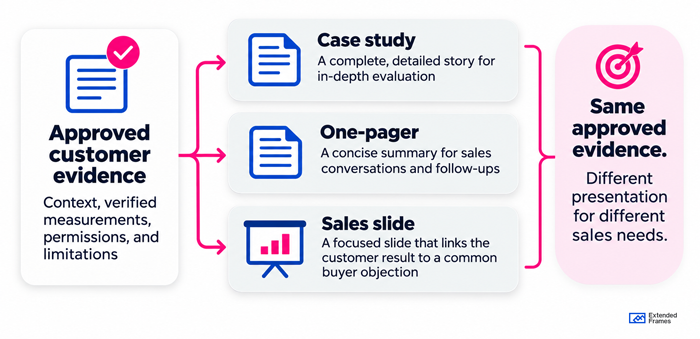
A public case study, a proposal, and a sales presentation may use the same customer evidence, but their readers approach it differently.
A website visitor is exploring what the company has accomplished. A procurement evaluator is checking whether specific requirements can be met. An executive reviewing a proposed investment may want the implications explained quickly.
Trying to serve all three audiences with an identical document can leave each searching for the information they need.
An illustrative example: from project evidence to sales material
Consider a hypothetical B2B technology company that has implemented a reporting automation system for a customer.
The customer previously spent ten hours preparing a recurring report. After implementation, the same reporting task takes six hours, based on comparable measurements.
Assume the customer has approved the figures and permitted their use in the formats below.
Illustrative Evidence Transformation
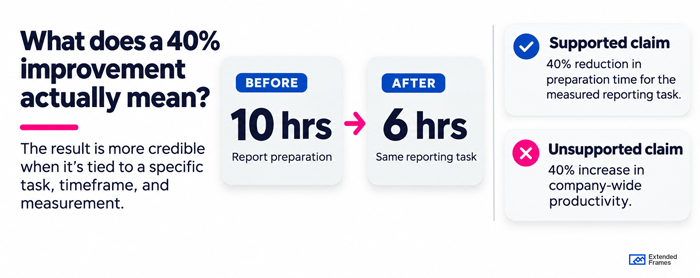
Supported claim: Report preparation time decreased by 40%, from 10 hours to 6 hours per reporting cycle.
Important: This is a hypothetical example demonstrating how to present measurable customer evidence. It does not represent actual customer results or Extended Frames project metrics.
Now consider how this evidence could be presented.
| Sales asset | What to include | What to avoid |
|---|---|---|
| Public case study | Original reporting problem, implementation, measurement method, customer-approved outcome | Presenting the result without explaining what was measured |
| One-page sales summary | Comparable customer situation, 10-to-6-hour comparison, concise explanation | Removing the reporting-task context from the percentage |
| Sales presentation | Before-and-after workflow, result, relevant implementation details | Claiming organization-wide productivity gains |
| RFP response | Documented scope, measurement basis, applicable implementation experience | Suggesting the same outcome is guaranteed for the prospect |
The source evidence stays consistent. The presentation changes according to the buyer’s question.
If a prospect is concerned about implementation, a process diagram may be more useful than a large results graphic. If finance is evaluating potential savings, the measurement method and scope become particularly important.
Extended Frames’ guide to turning an RFP proposal into a presentation explores a related decision: what evidence needs to be brought forward when evaluators already have the written proposal but still need to understand delivery and risk?
A case study intended for sales should anticipate those different uses before production begins.
Case study design should make the evidence easier to judge
Case study design often starts with a template: customer logo, introductory paragraph, testimonial, results, and supporting imagery.
That structure can work, but applying it without examining the content may bury the information buyers care about.
A prominent statistic catches attention. Its explanation establishes what the number means.
For a workflow improvement, a before-and-after diagram can show which steps changed. For a complex implementation, a timeline can clarify dependencies, responsibilities, and when the reported outcome was measured.
Where the evidence is qualitative, an accurately attributed customer quotation or a short description of the original problem may communicate more than a chart.
A reader should be able to identify the customer’s situation, understand the result, and locate the supporting details without working through several pages of promotional language.
This is similar to the editorial judgment discussed in designing B2B whitepapers worth reading. Evidence needs context, and the design should help readers understand its significance.
For customer case studies, an additional question shapes the design: which part of the evidence will a salesperson need to retrieve when the conversation becomes specific?
That may justify a separate results summary, an implementation diagram, or a short presentation version. It does not justify creating more formats than the team will realistically maintain and use.
Keep customer proof accurate after publication
A case study may begin with one approved document and gradually appear across a website, sales deck, proposal library, social posts, and campaign materials.
Each reuse creates an opportunity for the original evidence to change. A sales representative shortens a result for a slide. A marketing manager removes the measurement period to make room for a larger headline. Another team uses a customer logo in a campaign that wasn’t covered by the original approval.
None of those changes necessarily begins with an intention to mislead. But the final claims can become materially different from what the customer approved.
The solution requires clear ownership.A shared evidence record should identify the source of important claims, what was approved, where the material can be used, and who must review changes.
The people approving visual design should not automatically become responsible for certifying technical, financial, or operational claims.
This division of responsibility is discussed more broadly in Extended Frames’ article on brand governance and content ownership.
For case studies, it helps protect both the customer’s interests and the vendor’s credibility.
An outdated or poorly attributed result can create more work for sales than the original case study saves.
How to tell whether B2B case studies are helping sales
Case study performance is often reported through page views, downloads, or engagement. Those figures can describe content reach, but they don’t establish whether the material helped a buyer make a decision.
A better evaluation begins with how the sales team actually uses the evidence. Can representatives find a relevant customer example when an objection comes up? Do they use the approved assets or create their own versions? Which questions repeatedly go unanswered because the company lacks documented customer proof?
Those observations can identify useful improvements even without a sophisticated attribution system.
Where appropriate, teams can also examine whether case studies were used in opportunities, the stages where they were shared, and feedback from prospects.
A deal progressing after a case study was sent does not prove that the document caused the progression. Pricing, relationships, product suitability, and competitive factors may have influenced the result.
Treat opportunity data as supporting context rather than automatic proof of impact. If a case study receives little website traffic but is repeatedly used to answer a difficult procurement question, that may justify keeping it current. If another attracts substantial traffic but is rarely useful to sales, its purpose and audience may need reconsideration.
The important outcome is learning which customer evidence helps answer meaningful questions and where the gaps remain.
Build the next case study around evidence buyers can use
Before commissioning another customer story, review the material your company already has. Some projects may have strong documented outcomes but no published case study. Others may have excellent testimonials with very little supporting detail. A few may already contain everything sales needs, but the relevant information is buried in a long document or scattered across different files.
Those situations call for different decisions. Sometimes the priority is gathering better evidence. In other cases, the priority is rewriting the narrativ is rewriting the narrative, correcting an overstated claim, or producing a shorter sales-ready version. And sometimes the sensible decision is to leave a successful customer story unpublished because the necessary evidence or permissions are unavailable.
A useful B2B case study gives prospective buyers enough context to assess what happened and whether that experience is relevant to their own situation. Sales teams should be able to use the same approved evidence without changing its meaning.
If your team already has customer-approved stories, project results, or source material that needs clearer structure and design, Extended Frames’ marketing and brand design services can help develop those materials into case studies, presentations, and consistent sales collateral.