

How Design Amplifies Strategy and Turns Decisions Into Results
Design strategy is what helps a business move from a plan on paper to something people can understand, trust, and act on. Many companies have strong ambitions, solid leadership, and sensible goals, but still struggle to connect those goals to the customer experience, the product, the message, or the sales journey. That gap is where design does its most valuable work. When design is treated as part of strategy, it gives direction shape, reduces friction, and helps teams make better decisions with more consistency.
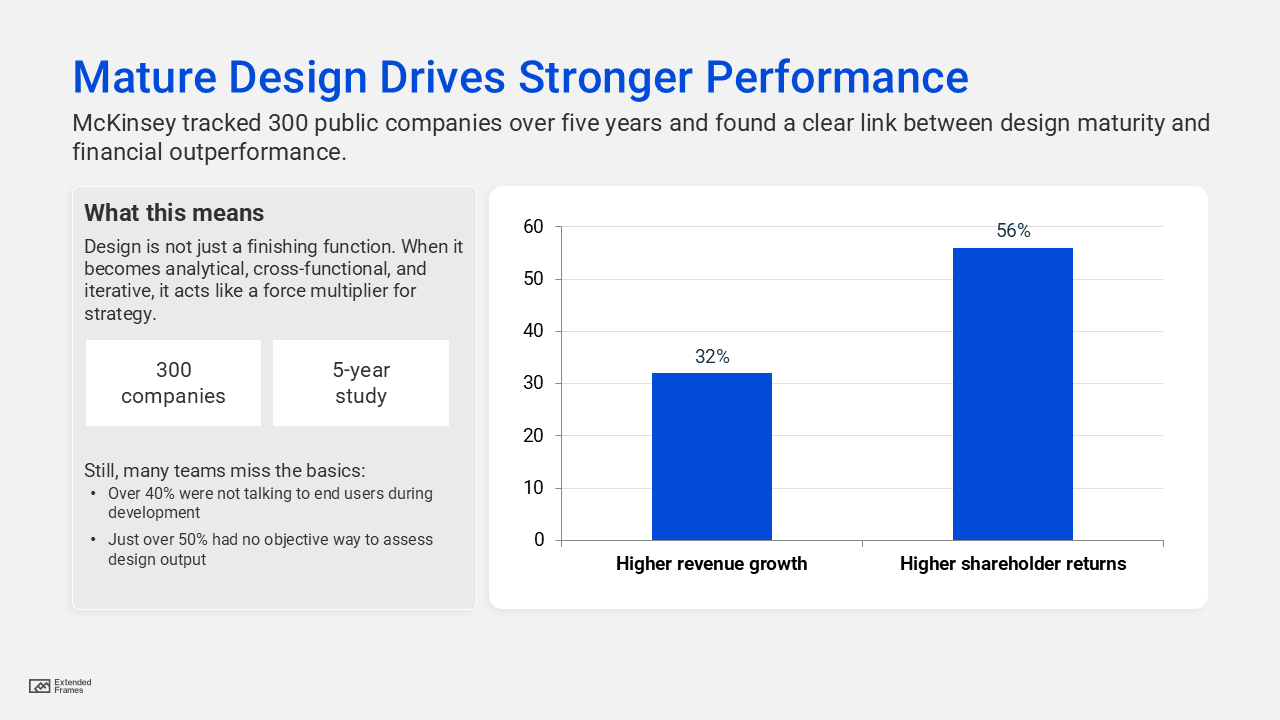
A lot of businesses still talk about design as decoration, output, or brand polish. The stronger view is this, design is how strategy becomes visible, usable, and believable. McKinsey’s study of 300 publicly listed companies found that top design performers achieved 32 percentage points higher revenue growth and 56 percentage points higher total returns to shareholders over five years compared with industry peers. This means companies that integrate design into leadership, customer understanding, and continuous iteration are more likely to outperform.
Why strategy often stalls without design
Most strategies fail for familiar reasons. They are too abstract. They stay trapped in slides, meetings, and internal language. Teams interpret them differently. Customers never feel the intended value. Leaders say one thing, product teams build another, marketing frames it differently, and sales has to improvise the rest.
Design helps close that gap because it forces clarity. It turns assumptions into choices. It reveals what a customer sees, what a user feels, and where a promise breaks down. Nielsen Norman Group defines UX strategy as a plan with three core parts: vision, goals and measures, and a plan. That structure matters because it is how the organization creates a coherent path from intent to execution.
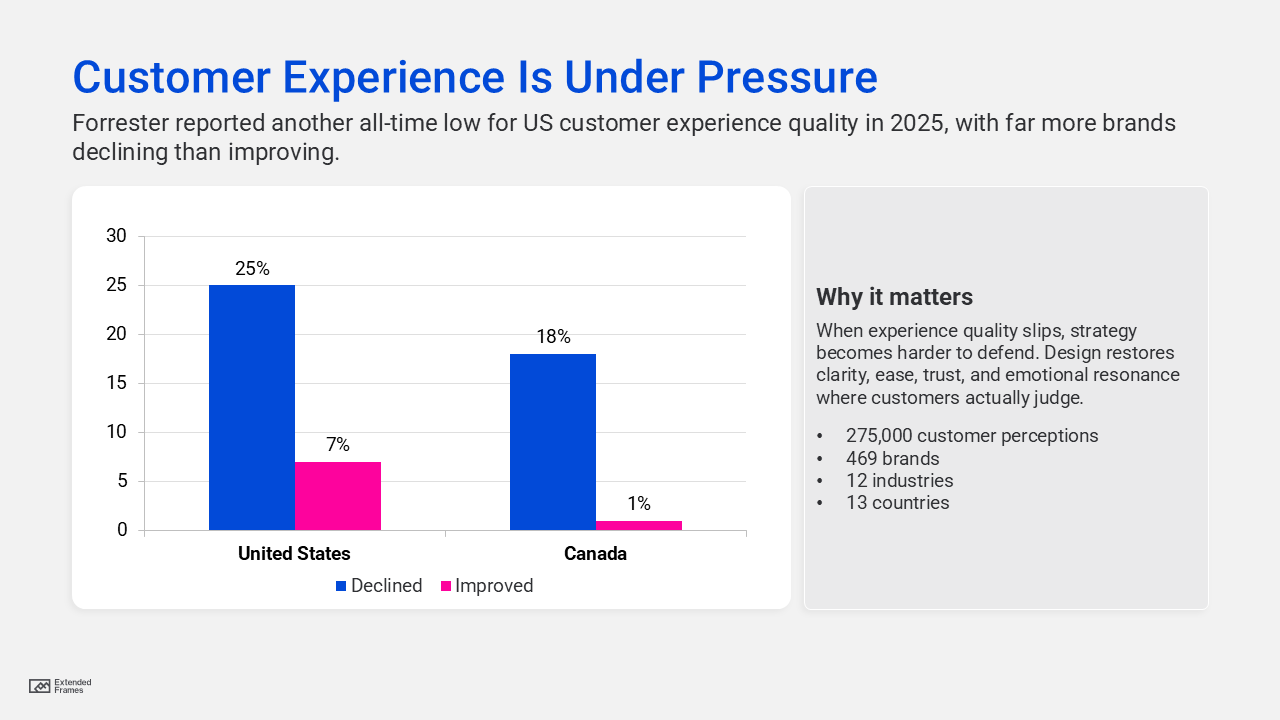
This is even more important now because customer experience quality is under pressure. Forrester reported that customer experience hit another all time low in North America in 2025, with only a small share of brands improving while many declined or remained flat. In other words, businesses do not lose ground only because they lack plans. They lose ground because customers can no longer feel the difference between what the company says and what the company actually delivers. Design is one of the clearest ways to fix that mismatch.
So what does design amplifies strategy means
To say design amplifies strategy does not mean design replaces strategy. It means design strengthens the signal.
A strategy usually answers questions like these:
- Where are we going?
- Who are we serving?
- What value are we trying to create?
- What tradeoffs are we willing to make?
Design takes those answers and makes them tangible:
- It shapes how the offer is understood
- It reduces friction in how people move through an experience
- It aligns product, brand, content, and sales touchpoints
- It helps teams test whether the strategy makes sense in real life
That is amplification. Design helps people see it, believe it, and move toward it.
Where design has the biggest strategic impact
1. Design makes customer value clear
A strategy can sound sharp in a boardroom and still land flat in the market. Design translates value into something people can grasp quickly. That includes the way a product is structured, the way a service is explained, the way a landing page guides action, or the way a presentation earns buy in.
When design is working strategically, customers do not need to work hard to understand what’s important. They feel the point faster.
2. Design helps teams prioritize better
Strategy is often more about deciding what not to do. Design supports prioritization by showing consequences. A messy interface, a vague pitch, a bloated workflow, or an inconsistent brand system usually points back to a strategic choice that was never resolved.
Design exposes ambiguity. That is useful. It helps teams identify what important most and what can be cut.
3. Design improves alignment across functions
One reason strategy gets diluted is that different teams carry different interpretations of the same objective. Design can act as shared language. It helps leadership, product, marketing, operations, and sales work from the same narrative and the same experience standards.
McKinsey’s research highlighted that strong design performance is linked to analytical leadership, cross functional talent, user experience focus, and continuous iteration. That is a strategic operating model, not a styling exercise.
4. Design makes change easier to adopt
People do not adopt change because a company announces it. They adopt change when the new experience feels easier, clearer, and worth the effort. Design plays a major role here. It lowers the cognitive load of change. It creates trust. It gives a new direction a form people can use.
This is true in products, internal systems, service delivery, presentations, proposals, and brand shifts.
A framework for using design strategy
| Stage | Strategic question | Design role | Output |
|---|---|---|---|
| Direction | What are we trying to achieve and for whom | Clarify the audience, value, and desired behavior | Strategy narrative |
| Translation | How should that strategy show up in the real world | Turn goals into messages, flows, visuals, and experience principles | Experience blueprint |
| Alignment | Are teams working toward the same outcome | Create shared systems, standards, and decision criteria | Design system, playbooks, templates |
| Validation | Does the experience support the strategy | Test assumptions with users, customers, and stakeholders | Insights, revisions, prioritization |
| Iteration | What needs to improve next | Refine based on evidence and changing context | Continuous improvement roadmap |
This framework mirrors the logic behind established UX strategy thinking, where vision, measurable goals, and a plan work together instead of sitting in separate documents.
How design amplifies strategy
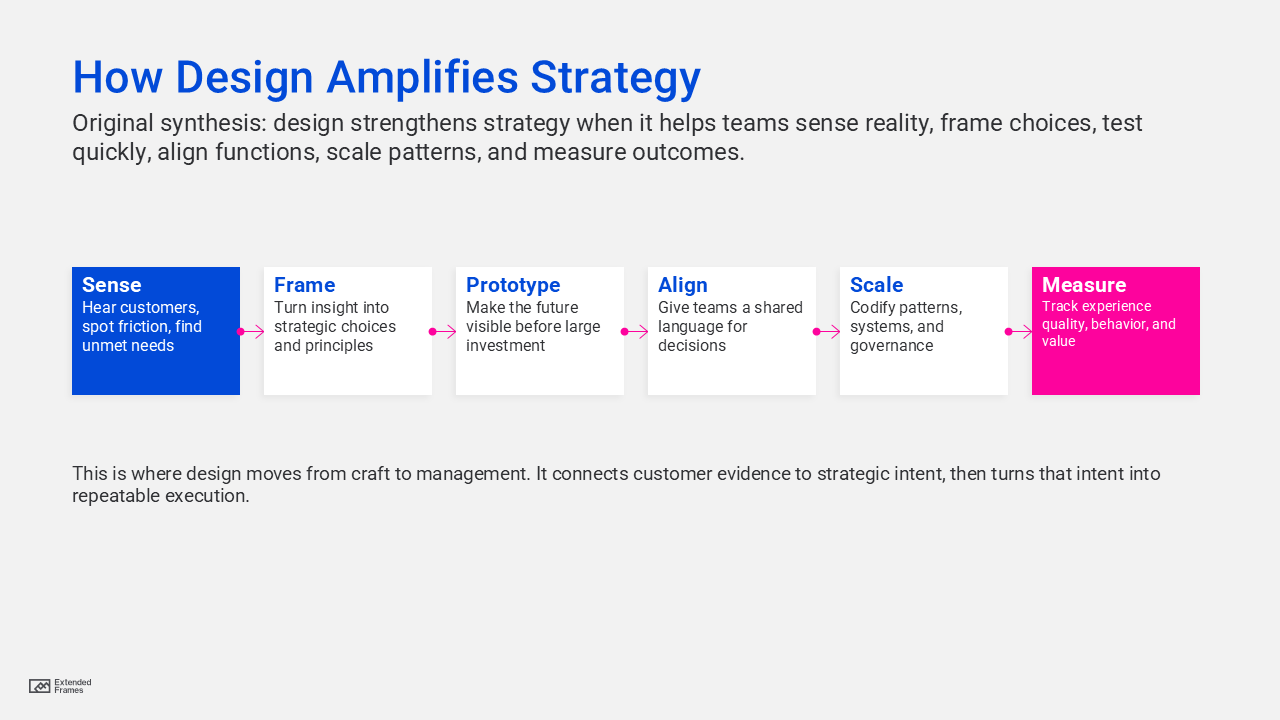
That flow is important because strategy does not prove itself at the moment it is announced. It proves itself when people experience it.
Evidence snapshot
| Finding | What it suggests |
|---|---|
| Top design performers achieved 32 percentage points higher revenue growth over five years | Design linked to stronger commercial outcomes when embedded in business practice (McKinsey & Company) |
| Top design performers achieved 56 percentage points higher total shareholder returns over five years | Design can contribute to long term business performance, not just short term polish (McKinsey & Company) |
| Design Council found businesses that see design as integral are more than twice as likely to report rapid growth | Treating design as core to business planning is associated with stronger growth outcomes (Design Council) |
| Forrester reported another all time low for CX in North America in 2025 | Businesses need clearer, more usable, more trustworthy experiences, which is where design matters strategically (Forrester) |
What this looks like in practice
A business presentation is a useful example. Leadership may have a strategy to enter a new market, reposition a service, or win internal approval for investment. The strategy itself may be sound, but without design, the story often becomes crowded, unclear, and harder to trust. The audience sees too much information, not enough hierarchy, weak evidence, and no clear decision path.
Strategic design changes that. It helps decide what the audience needs first, what proof matters most, what can be removed, and how the message should flow. The same principle applies to websites, proposals, onboarding journeys, campaigns, and product interfaces. Design helps them do their job better.
One mistake is bringing design in too late. By that point, the main decisions have already been made, and design is reduced to packaging.
Another mistake is separating brand design, product design, content, and service experience as if they are unrelated. Customers do not experience a business in silos. They experience one company. A fragmented experience weakens the strategy, even when each piece looks fine in isolation.
Strategic design should be measured by what it helps the business achieve like understanding, adoption, conversion, trust, consistency, and decision quality.
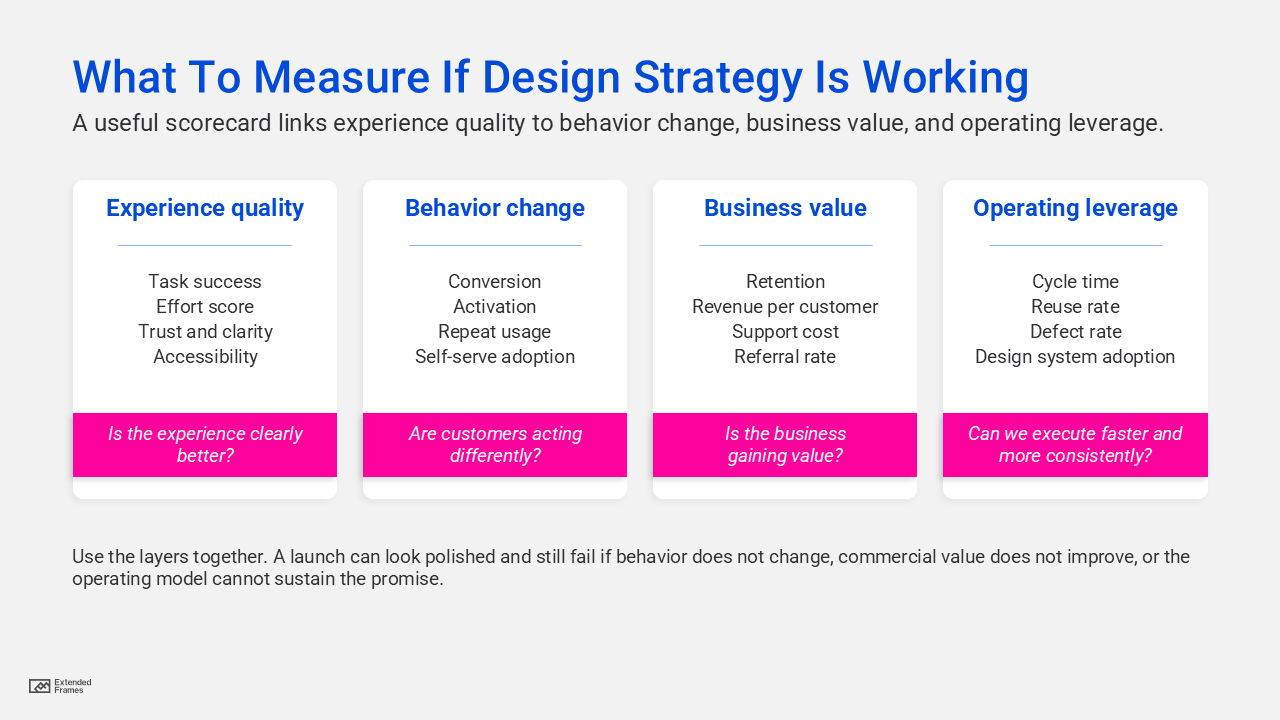
How to tell whether design is amplifying strategy
Ask these questions:
- Can a customer quickly understand the value being offered?
- Do different teams explain the same offer in the same way?
- Does the experience reflect the priorities leadership says matter?
- Are important decisions easier because design has clarified the tradeoffs?
- Are you learning from real user behavior and improving accordingly?
When the answer is a resounding yes, that means design is helping the business move.
Design amplifies strategy by turning intention into experience. It helps businesses express value more clearly, align teams more effectively, reduce friction, and adapt with better feedback. That is why design belongs near decision making, not only near delivery.
The companies that benefit most from design are the ones using design to sharpen choices, build trust, and make strategy real for the people who matter most. When that happens, design stops being the finishing touch and becomes a business advantage.