

Pitch deck vs sales deck: the simplest way to choose the right one
When you search for a pitch deck vs sales deck, you probably want clarity on one thing: who you are presenting to, and what decision you need next. A pitch deck is for investors deciding whether your company is worth a meeting and funding. A sales deck is for customers deciding whether your solution is worth time, budget, and change. These decks can share visuals, but they should not share the same story.
Pitch deck vs sales deck quick comaprison
| Item | Pitch deck (investors) | Sales deck (customers) |
|---|---|---|
| Main goal | Get a meeting, then move to diligence | Move the deal to the next step |
| Main question | Is this a big business, and can this team win | Will this solve our problem, with acceptable risk |
| Proof that matters most | Market, traction, business model, team | Outcomes, case studies, adoption plan, ROI |
| Best format | Easy to scan, clear slide titles | Easy to present live and share internally |
| What to avoid | Long text, unclear story, missing traction | Feature dumping, generic story, weak proof |
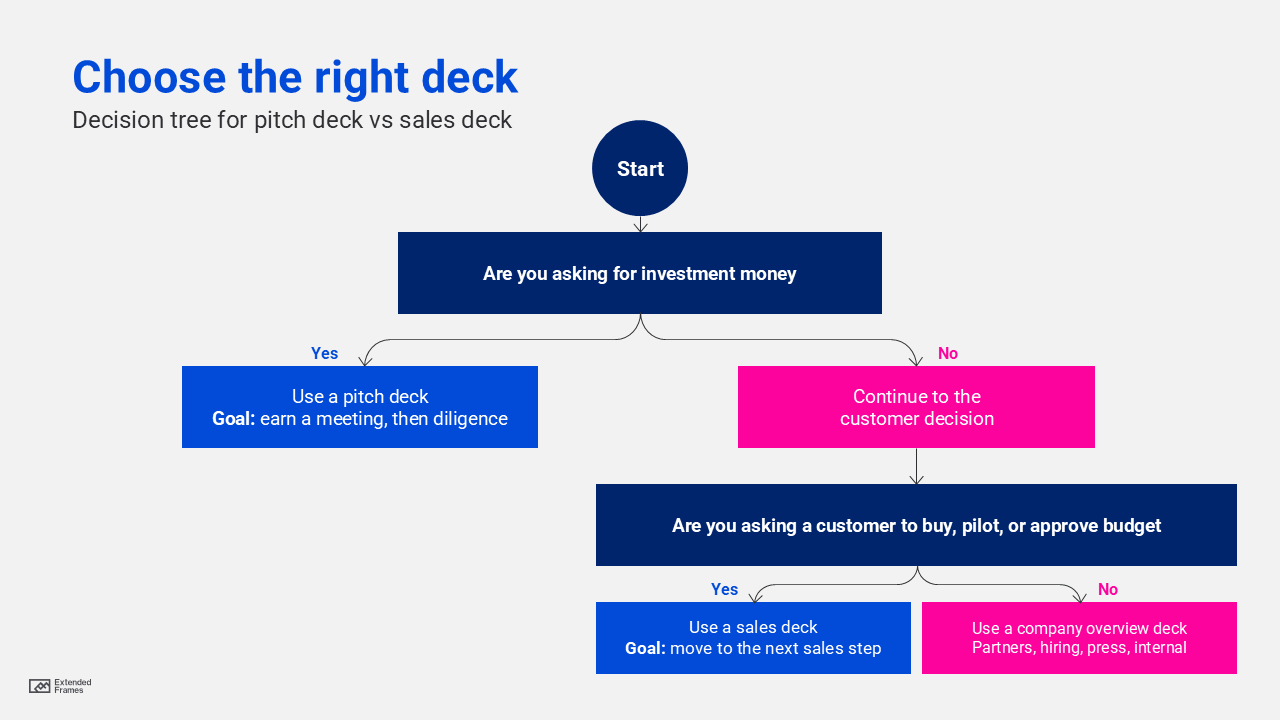
Quickest way to choose your deck
Why the two decks need different pacing
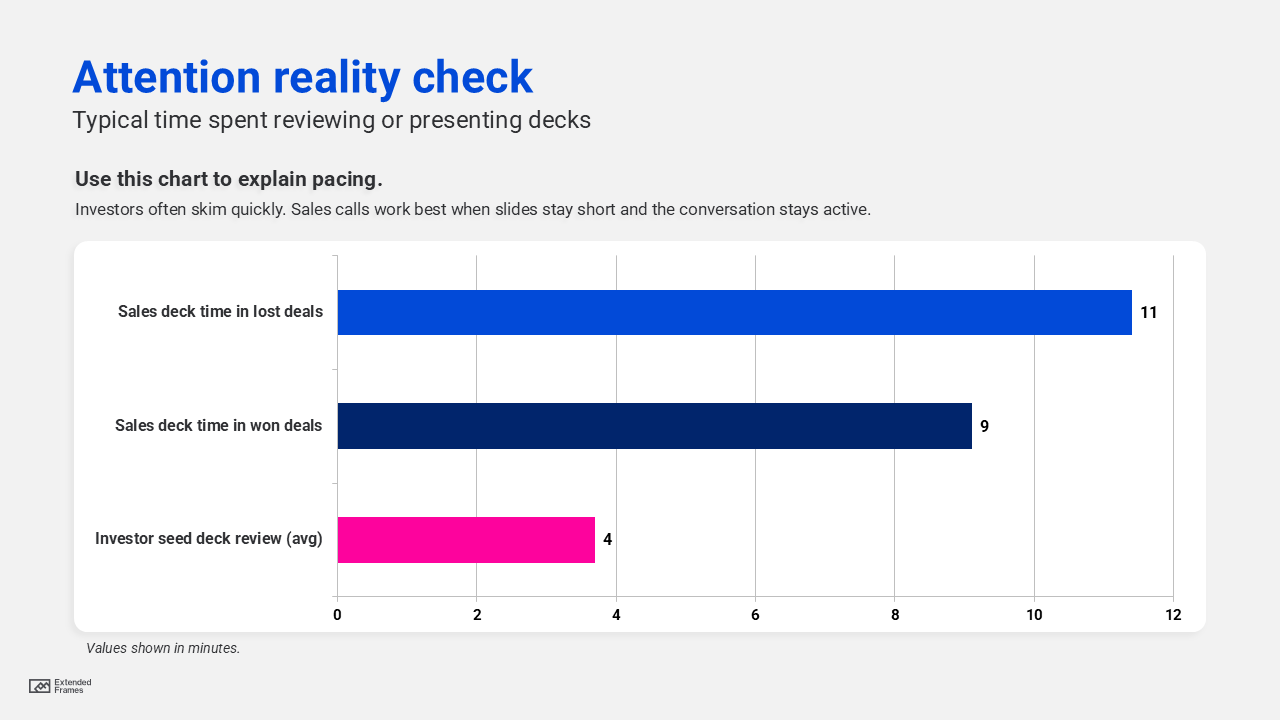
Investors move fast. DocSend reports that a VC may spend about 3 minutes and 44 seconds reviewing a seed deck on average, and it notes that successful decks can be shorter and quicker to understand.
Sales calls also need restraint. Gong reports that intro calls that closed spent about 9.1 minutes showing slides, while lost deals spent about 11.4 minutes.
Attention reality in minutes
The pitch deck,what it is and what to include
A pitch deck is a short story that helps an investor understand your company quickly and decide whether to take the next meeting.
Sequoia’s well known outline starts with a clear company purpose, then problem, solution, and the business basics investors evaluate. YC also shares practical guidance on building a seed round pitch deck.
Pitch deck slide template, slide by slide
| Slide | Purpose | What to show |
|---|---|---|
| 1. Company in one sentence | Make it obvious what you do | One clear line, no buzzwords |
| 2. Problem | Prove the pain is real | Who has it, why it matters now |
| 3. Solution | Show your new way | How you solve it, in plain language |
| 4. Why now | Explain timing | What changed in the market or world |
| 5. Market | Show upside | Target segment first, then sizing |
| 6. Product | Make it tangible | Simple flow, a few key screens |
| 7. Traction | Prove demand | Growth, retention, pipeline, or pilots |
| 8. Business model | Show how you make money | Pricing, margins direction, unit logic |
| 9. Competition | Show the landscape | Where you win and why |
| 10. Team | Show you can deliver | Relevant wins, domain strength |
| 11. Financials (optional) | Show drivers | Assumptions and milestones |
| 12. The ask | Make next step easy | Amount, use, and next milestone |
Quick test: if someone only reads your slide titles, they should still understand the story.
The sales deck: what it is and what to include
A sales deck is a tool for a buying conversation. It should match the buyer’s situation, show proof, reduce risk, and end with a clear next step.
Gong’s guidance on sales presentations emphasizes keeping the presented portion tight so the call stays a conversation, not a lecture.
Sales deck slide template, built for buyers
| Slide | Purpose | What to show |
|---|---|---|
| 1. The buyer’s world | Prove relevance fast | Their industry, role, and pain |
| 2. Cost of the problem | Create urgency | Time, risk, money, missed growth |
| 3. What success looks like | Set a clear target | Outcomes and measures that matter |
| 4. Your approach | Explain how you work | Your method in 3 to 5 steps |
| 5. How it works | Make it real | A simple workflow or architecture |
| 6. Proof | Build trust | Case studies, results, references |
| 7. Why you, not others | Help them choose | Clear differences, not insults |
| 8. Rollout plan | Reduce fear | Timeline, ownership, support |
| 9. Pricing and packaging (when relevant) | Enable decision | Options and how to start small |
| 10. Next step | Move forward | Pilot, security review, proposal, meeting |
Quick check: every slide should help the buyer say “yes” to the next step.
Here is the clean rule
A pitch deck sells the future, a sales deck sells the outcome.
What you can reuse safely
- Product screenshots and diagrams
- A short company intro
- Credibility logos (use a few, not a wall)
- A short proof library (quotes, numbers, case studies)
What you must rewrite
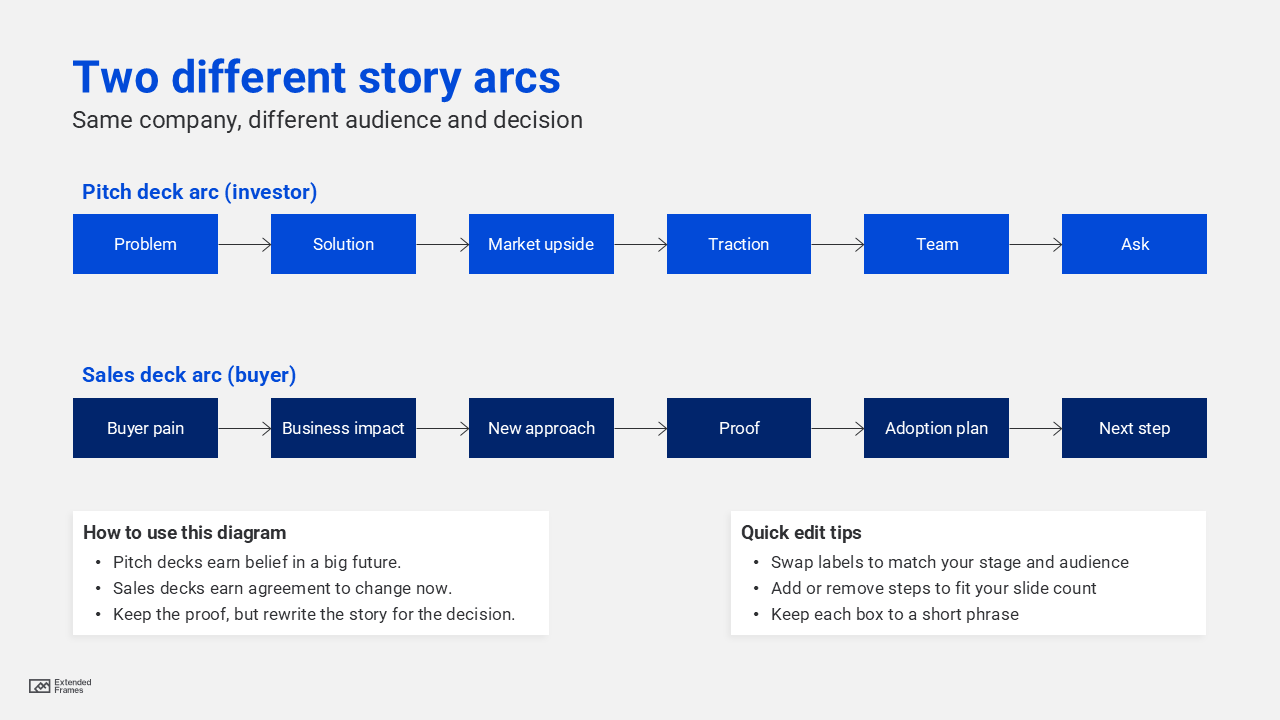
- Market size becomes buyer impact
- Fundraising ask becomes a buying next step
- Traction becomes customer proof
- Competition becomes alternatives and decision criteria
A simple conversion method
One story, two versions
Quick conversion steps
- Keep the best 3 product visuals.
- Replace market size with a buyer impact slide (time saved, risk reduced, revenue gained).
- Replace the ask with a next step slide (pilot plan, meeting, proposal).
- Add an implementation slide to reduce fear.
- Add proof that looks like the buyer’s world (case studies in the same industry).
What to measure
Pitch deck
- Replies after sending the deck
- Meetings booked
- Follow up questions on traction and model
DocSend’s research on fundraising and deck engagement is useful as a benchmark for investor attention.
Sales deck
- Next step rate after the call
- Stakeholder forwarding (does it get shared internally)
- Shorter deal cycles
- Fewer repeated objections
Gong’s data on slide time is a good reminder to keep the slide portion tight.
Closing
If you get the audience right, the deck becomes much easier to write. Pitch deck vs sales deck is not a design choice. It is a decision choice. Investors need a clear reason to believe. Buyers need a clear reason to change.